OKRs · The OKR Manual, No. 6
The OKR Cycle: Rituals That Make or Break Execution
OKRs do not die in the setting session. They die around week four, when the document nobody opened becomes the document nobody opens at all.

You can write perfect OKRs and still watch them die. Not in the setting session, where everyone is fresh and the whiteboard is full of good intentions. They die around week four, quietly, when the document nobody has opened since the kickoff becomes the document nobody opens at all.
The writing (Article 5) is a one-day event. The rhythm is the whole quarter, and it is where most implementations go to fail. A good OKR without a cadence around it is just a wish you wrote down in a nicer format.
So this article is about the operating rhythm: what the cycle looks like, what the weekly check-in is really for, and why the meeting most teams run is the exact opposite of the one that works.
First, the cost
Before the mechanics: this takes time, every week, and if you can't protect that time you should not start (see the readiness test, Article 4).
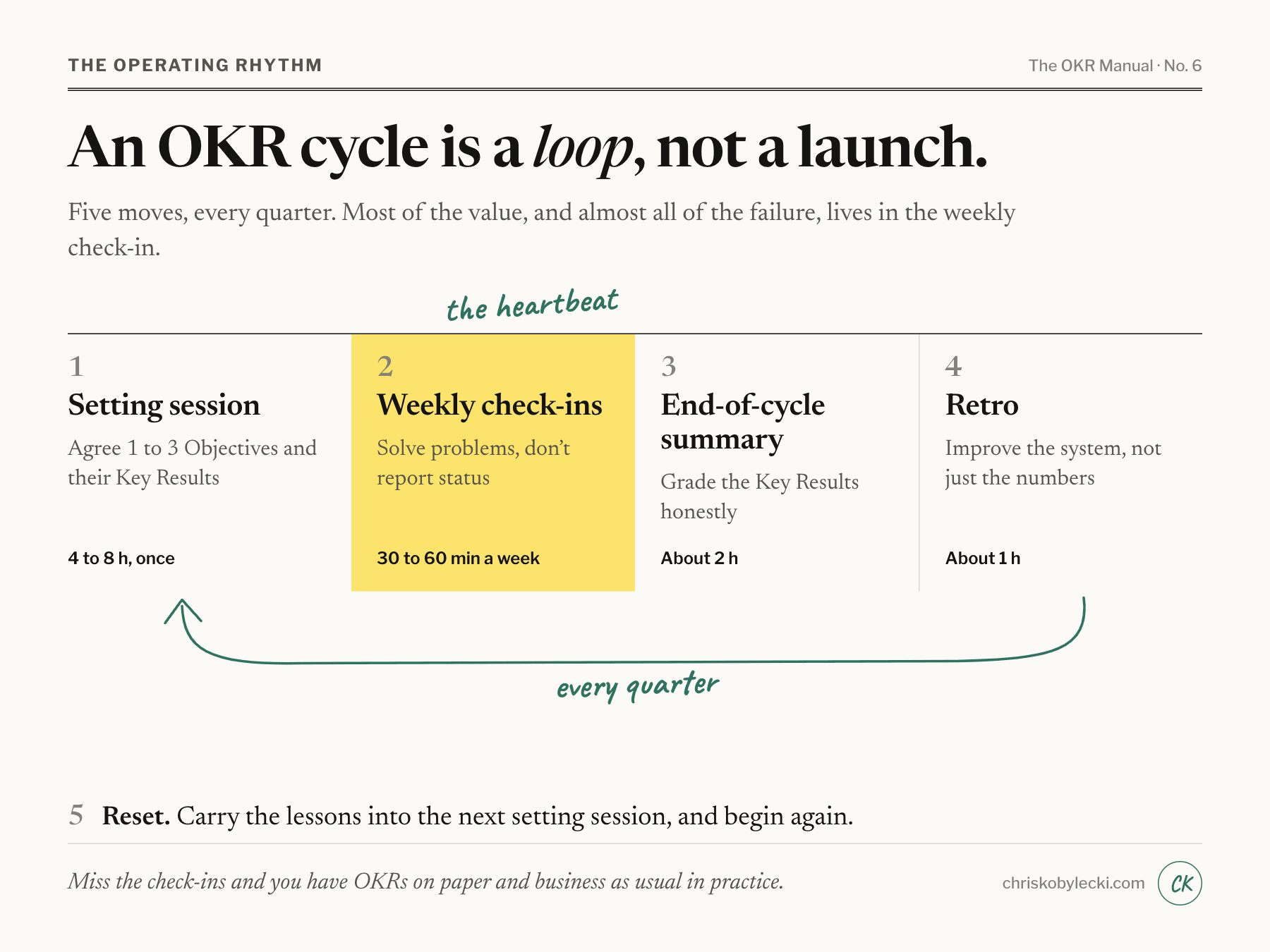
Here is the real bill for one quarter:
- Setting the cycle: four to eight hours, once, up front.
- The weekly check-in: thirty to sixty minutes, every week.
- The end-of-cycle summary: about two hours.
- The retro: about one hour.
Averaged across the quarter, that is roughly one to two hours a week of leadership time. Not enormous, but non-negotiable. The teams that fail almost never fail because the number was too big. They fail because they treated it as optional the first week something urgent came up, and then every week after. If you have no meeting rhythm in your company at all, build that habit first, before you add OKRs on top of it.
The cycle, end to end
An OKR cycle is a loop, not a launch. Five moves, in order, every quarter:
- Setting session. Leadership agrees the one to three Objectives and their Key Results for the cycle. This is the four-to-eight-hour event.
- Weekly check-ins. The heartbeat. Short, regular, same time every week, for the whole quarter.
- End-of-cycle summary. What did we actually move? Grade the Key Results honestly.
- Retro. Not on the numbers, on the system. What in how we worked helped or got in the way?
- Reset. Carry the lessons into the next setting session, and begin again.
Most of the value, and almost all of the failure, lives in step two. So that is where we'll spend the rest of this article.
The check-in is the heartbeat
The weekly check-in is the single ritual that decides whether your OKRs are alive. Miss the setting session and you have no OKRs. Miss the check-ins and you have OKRs on paper and business-as-usual in practice, which is worse, because now you have the paperwork too.
But not any meeting will do. The check-in has a job, and it is not the job most teams give it. Run in the right order, it takes half an hour and changes what people do on Monday. Here is the running order that works:
- Updates entered before the meeting. Every owner updates their numbers and confidence before anyone sits down. The meeting is not for data entry. If you're reading numbers out loud for the first time in the room, you've already lost half the time.
- Reporting. Quick pass: what moved since last week? Progress, not narrative.
- Review. For each Key Result, what's our confidence it lands by end of cycle? On track, needs attention, or at risk.
- Obstacles. The real content. What is the single biggest thing in the way of the at-risk results?
- Action steps. Who does what, this week, to clear those obstacles? Named owners, concrete actions.
- Closing. A one-line summary of what was decided, so everyone leaves aligned.
Reporting and Review should be fast, because the updates were already entered. The time goes where it belongs: Obstacles and Action steps. That is the difference between a meeting that moves the numbers and one that merely reads them.
The check-in autopsy
The fastest way to see what a check-in is for is to watch the same team run the same numbers two different ways. Same Key Result, at risk, sitting at 40% against a 60% target with three weeks left.
The status-theater version:
"Activation's at 40%, target's 60%. Bit behind. We're pushing on it." "Okay. Anyone else? Sales, you're up."
Everyone reported. Nobody is any wiser. The number was announced, a vague reassurance was offered, and the meeting moved on. Next week it will be at 41%, and the same non-conversation will happen again, until the cycle ends and everyone agrees activation "just didn't land this quarter."
The problem-solving version:
"Activation's at 40%, target's 60%, and I'm flagging it at risk, not on track." "What's the actual blocker?" "New users hit the empty dashboard and don't get to first value. It's the onboarding, not the acquisition." "So what would move it fastest?" "A guided first-run. Design has a mockup. I need two engineers for a week." "Take them from the billing work, that KR's on track and can wait. Let's recheck this number Thursday."
Same team, same numbers, completely different meeting. One reported a problem. The other solved one. The check-in is the half-hour a week where the team does its strategic problem-solving out loud, together, not a status report you perform for leadership. If your check-ins feel like a series of updates aimed at the boss, you're running the first version, and your OKRs are already dying.
Grading, confidence, and why green isn't the goal
At the end of the cycle you grade the Key Results, and here is where OKRs surprise people: you are not aiming for all green.
If every Key Result hits 100%, you did not have a brilliant quarter. You sandbagged. You set targets you already knew you'd clear, which means you aimed the whole company at goals that required no stretch at all. A good Key Result is ambitious enough that landing it is uncertain.
Which is why, for stretch goals, hitting around 70% is a win. It means you set the bar high enough to pull real effort out of the team and still moved the number a long way. Grading is honest calibration, not a report card: did we aim well, and did we move? A wall of green means the answer to the first question is no.
Two cautions. First, keep stretch goals (the OKRs, roughly 30% of your energy) separate from commitments that simply must ship, like payroll or compliance; those are closer to KPIs and you do want them at 100% (Article 3). Second, a red number is information, not a verdict on a person. The moment red becomes a punishment, people stop reporting it honestly, and your whole system starts telling you comfortable fiction.
Know where the numbers live
One quiet killer, and an easy one to fix: not having a single, agreed place where each number lives.
You do not need an expensive dashboard. You need to know, for every Key Result, exactly where its number comes from and who updates it, so the pre-meeting update takes five minutes and not an afternoon of hunting. Teams that skip this end up spending the check-in arguing about whose spreadsheet is right instead of what to do next. Decide the source for each number once, at setting, and the rhythm runs itself.
Common mistakes to watch
- Skipping check-ins when things get busy. The busy weeks are exactly when the focus matters most. Protect the slot.
- Running the meeting as a status report. If leadership talks more than the owners, it's theater. Spend the time on obstacles.
- Entering updates live. Do it before. The meeting is for thinking, not typing.
- Chasing all green. Green everywhere means the targets were too soft, not that the quarter was great.
- Punishing red. Do it once and you'll never see an honest number again.
The takeaway
OKRs are a rhythm, not a document: a setting session, a weekly check-in that solves problems instead of reporting them, an honest grading, and a retro that improves the system for next time. The check-in is the heartbeat, and its job is Obstacles and Action steps, not status. Aim high enough that around 70% is a win, keep red safe to say out loud, and know where every number lives.
None of this is complicated. It is just relentless. OKRs surface problems; they don't solve them, the cadence is what turns a surfaced problem into a decision, week after week, until the strategy actually shows up in what people do.
Next: your first cycle will be bad. We mean that literally, and we'll show you why running it anyway is the only way it ever gets good.