OKRs · The OKR Manual, No. 7
Your First OKR Cycle Will Be Bad. Run It Anyway.
Not might be. Will be. The single most common way OKRs die is a leadership team that quits three weeks before it would have started working.

We tell every client the same thing before we start, and it always lands like a warning: your first OKR cycle will be bad. Not "might be." Will be. The check-ins will drift, some numbers won't add up, and at least one team will quietly carry on as if none of it is happening.
We say it out loud on purpose, because the single most common way OKRs die is neither a bad framework nor a lazy team: it is a leadership group that ran one rough quarter, decided "OKRs don't work here," and walked away three weeks before it would have started working. This article is the inoculation against that. Cycle one is supposed to be rough. Once you expect it, the rough parts stop being a verdict and start being the most useful information you'll get all year.
What cycle one actually looks like
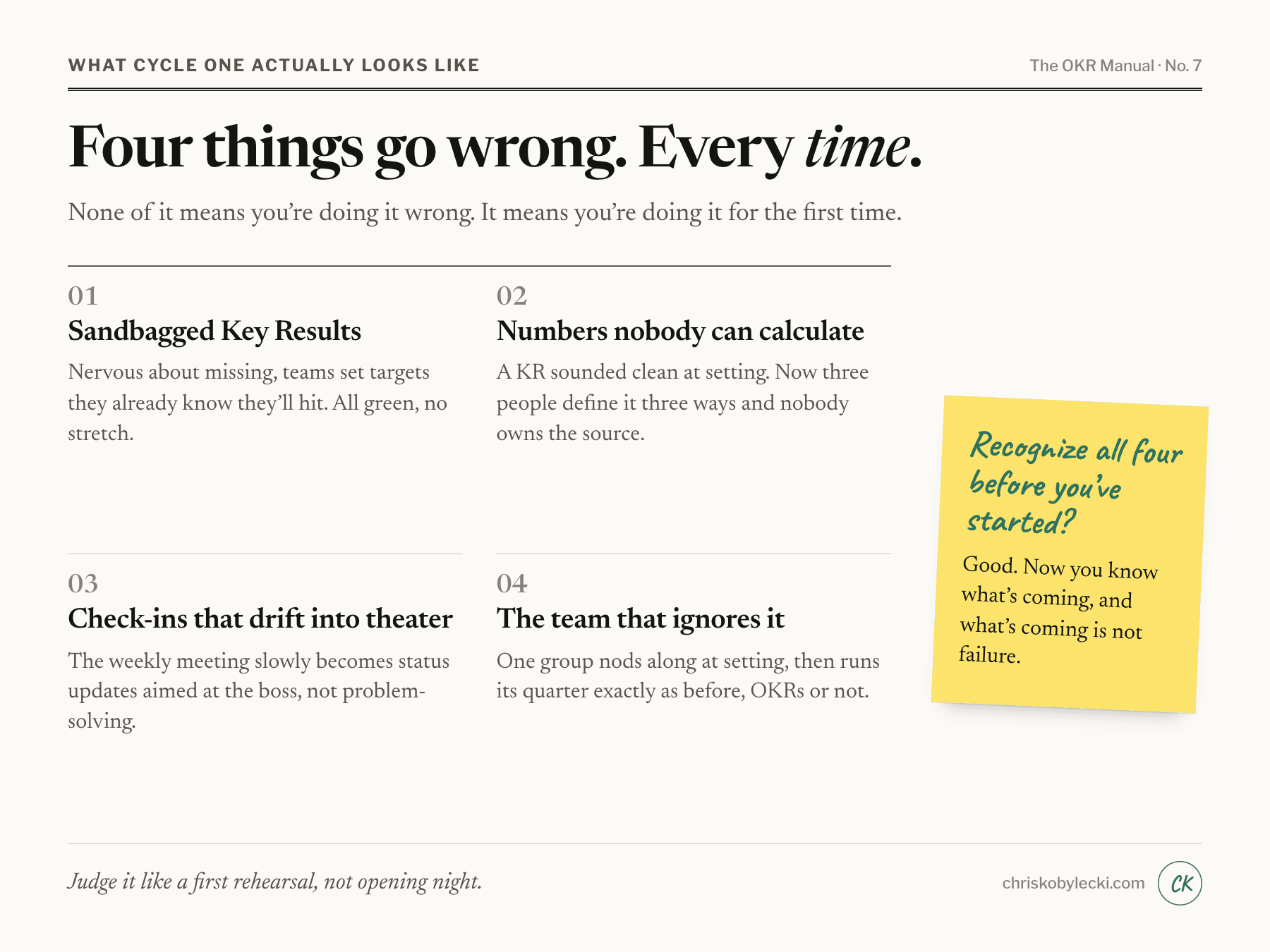
Here is the mess we see, almost every time, in almost every company. It means you're doing it for the first time, not doing it wrong.
- Sandbagged Key Results. Nervous about missing, teams quietly set targets they already know they'll hit. Come quarter end, everything is green, and none of it required a stretch.
- Numbers nobody can calculate. A Key Result sounded clean at setting, then it turns out three people define it three ways and nobody actually owns the source.
- Check-ins that drift into theater. The weekly meeting slowly becomes a round of status updates aimed at the boss, instead of the problem-solving it's meant to be (Article 6).
- The team that ignores it. One group nods along in the setting session and then runs its quarter exactly as before, OKRs or no OKRs.
If you recognize all four before you've even started, good. Now you know what's coming, and what's coming is not failure.
Calibration, not failure
The deliverable of cycle one is a working system, not green scores.
The first time round, hitting your OKRs matters less than finding out where your operating system leaks: which numbers have no owner, which rituals don't hold, which "priorities" nobody can actually name under pressure. A first cycle that surfaces all of that has succeeded, even if every Key Result comes in red. A first cycle that produces a wall of green while teaching you nothing has failed, quietly, and you won't find out until cycle two lands just as flat.
Judge cycle one the way you'd judge a first rehearsal, not opening night. The point is to run the whole thing end to end, with real stakes, and watch where it strains. That strain is the feedback you're paying for.
Bad results are the most useful data you'll get
Every rough spot in cycle one is a specific problem, pointing at a specific fix, most of them straight back to the failure modes in Article 2. Read the mess as a diagnostic:
- A Key Result nobody could update means the number had no owner or no agreed source (Article 2's clarity-of-numbers problem). Fix: assign an owner and a single source to every KR before cycle two starts, not during it.
- A check-in that became a status meeting means the ritual drifted. Fix: re-run the agenda from Article 6, updates entered before, time spent on obstacles.
- Seven objectives nobody could recite means you never actually chose (priority, not priorities). Fix: cut to one to three, out loud, and let the rest wait.
- All green, no stretch means your targets were too soft. Fix: aim higher next time, where landing 70% is a win.
- The team that opted out means that group didn't really buy in. Fix: get its leader committed, or leave them out of cycle two rather than pretending.
None of these are reasons to stop. Every one is a named, fixable thing you now know about your company that you did not know a quarter ago. That is what a first cycle is for.
The retro that saves cycle two
All of this comes together in the end-of-cycle retro, and cycle one's retro is the most valuable meeting in the whole system. A retro on how you worked, not on the numbers.
Keep it to three honest questions:
- What do we keep? The rituals that held, the KRs that pulled effort, the moments the check-in solved something.
- What do we fix? The numbers with no owner, the meeting that drifted, the objectives that multiplied.
- What do we stop pretending about? The team that never engaged, the metric we can't really measure, the target we sandbagged.
Answer those three with the whole leadership group in the room, and cycle two starts from a system you've already debugged once. That is the compounding you lose when you quit after one quarter: cycle two is cycle one with the biggest leaks sealed, not another cold start.
The quit trap
The reason we open with the warning is that the alternative is so predictable. A team runs a rough first quarter, feels the friction, and concludes the tool is broken. They quit.
Judging OKRs on one cycle is judging the gym after one workout. You are sore, nothing looks different in the mirror, and by that logic exercise "doesn't work." The whole value of OKRs is in the repetition: the same loop, run again and again, each turn a little sharper than the last. One cycle is barely a warm-up, not a fair test.
The teams that win with OKRs are almost never the ones with a brilliant first quarter. They're the ones who ran an ugly first quarter, held the retro, and showed up for the second.
When "bad" is actually a red flag
Not all rough is the same, and one kind of bad is a real warning rather than a normal first-cycle wobble.
If leadership skipped the check-ins, if the CEO treated OKRs as something the team does while they stay above it, if nobody with authority ever showed up to make the hard calls, then the problem is ownership, not calibration, and no second cycle will fix a first cycle that leadership never joined. That's the readiness test (Article 4) telling you something you skipped, and the honest move is to go back and fix it before running another quarter.
The line is simple. Messy execution is normal and fixable. Absent leadership is a missing foundation, not a mess.
Why we set the expectation
Most OKR content sells the highlight reel: adopt the framework, watch the magic. We do the opposite. We tell clients cycle one will be hard, because setting that expectation is the retention strategy. A team braced for a rough first quarter treats the friction as progress and keeps going. A team promised a smooth one treats the same friction as failure and stops.
OKRs surface problems; they don't solve them, and cycle one surfaces the most problems of all. That is the system doing its single most valuable job, on day one, before you've paid the price of learning it any harder way.
So run it. Let it be bad. Hold the retro, fix the leaks, and run it again. That is the only version of adopting OKRs that has ever worked.
That closes the foundations. You know what OKRs are, why they fail, how they differ from KPIs, whether you're ready, how to write them, how to run the rhythm, and what to expect the first time through. Next, we leave the theory and get specific, starting with the companies we know best: how OKRs actually play out inside a software service business, and the traps unique to running them there.