OKRs · The OKR Manual, No. 9
OKRs for B2B SaaS & Product Companies
Product companies have read all the OKR advice, and many still watch the plan fade by week four. The fix is to measure impact, not shipping.

Product companies have read all the OKR advice. Most of it was written for them. And many of them still watch the plan fade by week four.
The usual reason is not that the framework is wrong for software. It is that a product company has so many legitimate things going on that OKRs become a relabeled roadmap, and a roadmap is a list of things to ship. Shipping is the easy part. This article is about what to measure instead.
The situation
A B2B product company at 100 people or more has several squads, a roadmap that sales and customer success both lobby for, and a growth team running its own experiments. Each group has a plan, and each plan is sensible. A common pattern: the kickoff has energy, week three is busy, and by week four the OKR document stops being opened.
Execution does not fade because people stop caring. It fades because the weekly rhythm never forces a decision, and a document nobody has to decide anything from is easy to ignore.
Shipping is not impact
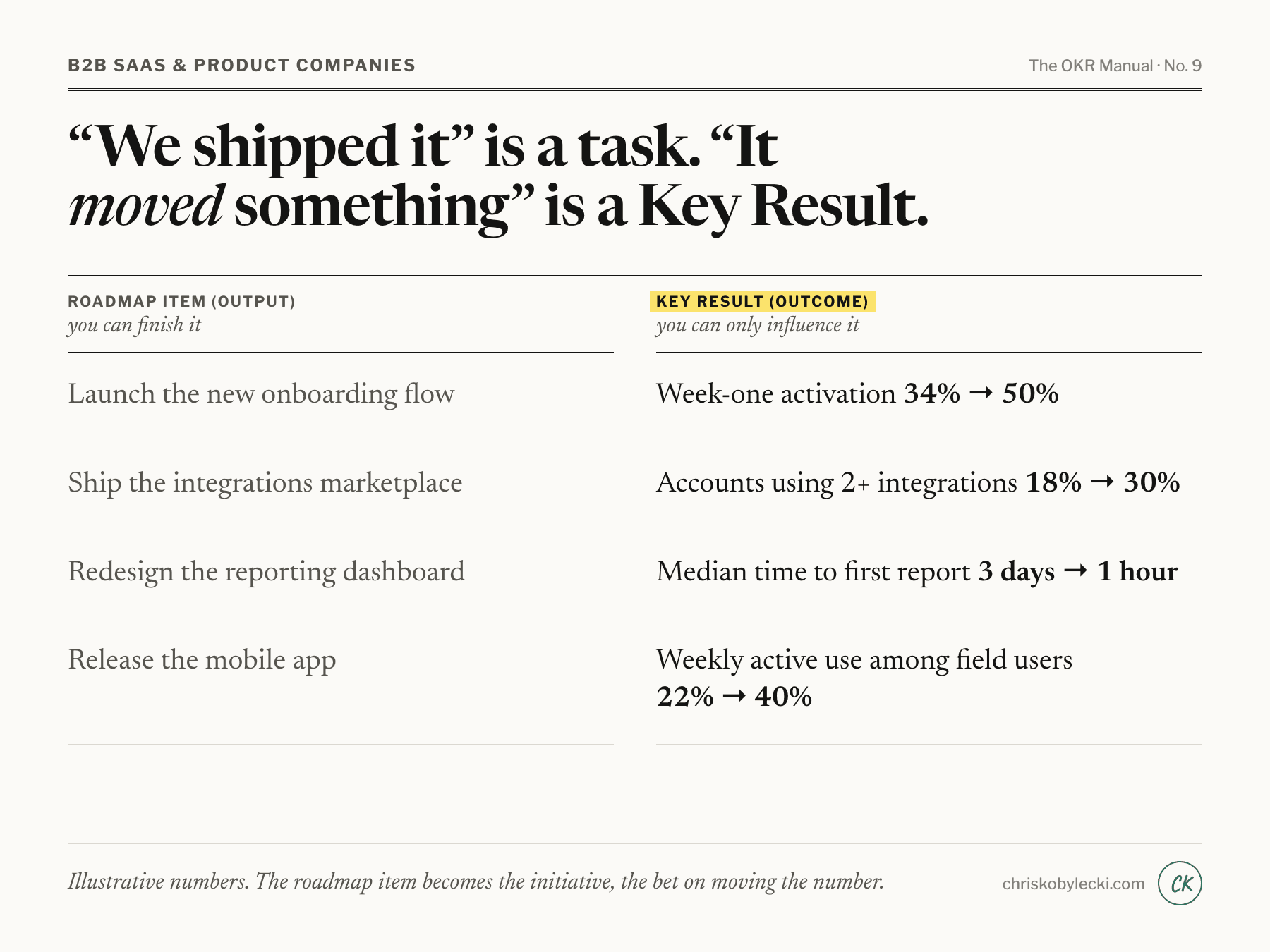
The sharpest version of the output-versus-outcome problem lives here. "Launch v2" is a Key Result in a surprising number of product OKRs, and it is satisfying to tick. It tells you the team shipped. It tells you nothing about whether a customer is better off.
Rewrite it the way Article 5 teaches, and the question changes from "did we build it?" to "did it move anything?"
| Roadmap item as a KR | Value-based KR (illustrative numbers) |
|---|---|
| Launch the new onboarding flow | Raise week-one activation from 34% → 50% |
| Ship the integrations marketplace | Raise accounts using two or more integrations from 18% → 30% |
| Redesign the reporting dashboard | Cut median time to first report from 3 days → 1 hour |
| Release the mobile app | Raise weekly active use among field users from 22% → 40% |
The roadmap item does not disappear. It becomes the initiative, the bet on how to move the number. If the redesign ships and time to first report does not move, the bet was wrong, and you want to find that out in the quarter and not at the annual review.
An example (illustrative numbers)
Objective: Turn our product into a habit
- KR1: Weekly active accounts from 41% → 55% of paying accounts
- KR2: Median time to first value from 9 days → 3 days
- KR3: Net revenue retention from 98% → 106%
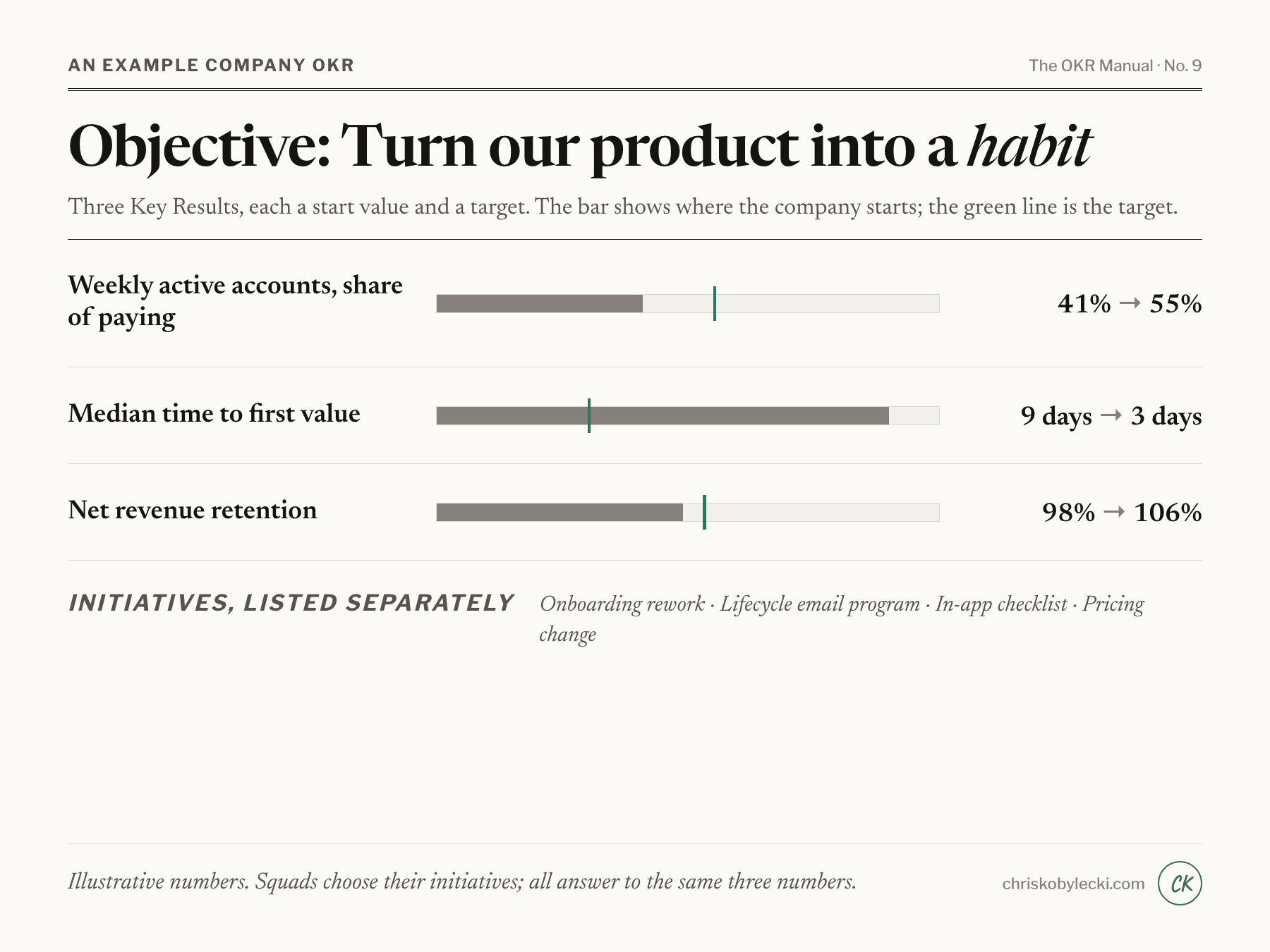
Three numbers that describe the same story from different angles: customers start faster, use it more often, and stay and expand. The initiatives are separate and many: onboarding rework, a lifecycle email program, an in-app checklist, a pricing change. Squads pick the initiatives they believe in. They are all accountable to the same three numbers.
Aligning product, growth and sales without the 200-KR explosion
The temptation in a product company is to give every function its own full OKR set and then draw lines between them. The result is forty Key Results that nobody can hold in their head.
A simpler rule works better. The company sets one or two objectives. Each function then names the Key Results it can move, and writes only those. Product owns time to first value. Growth owns activation. Customer success owns retention. Sales may own the quality of the accounts that come in, which shows up in everyone else's numbers a quarter later.
When two functions share a number, say so. A shared KR with two owners and no agreement on who does what is the fastest way to produce a blame game in week six.
Make the weekly check-in force a decision
The week-four fade has a mechanical fix. Keep the check-in to 30 minutes and organize it around one question: which decision are we changing because of what these numbers say?
If activation is flat, which squad moves this week? If retention dropped in one segment, who looks at the cohort? A check-in that ends with a decision, an owner and a date is hard to let lapse, because the next one starts from the previous one's commitments. Article 6 has the full agenda.
Where it goes wrong
Roadmap items disguised as Key Results. If you can finish it, it is a task. A Key Result is something you can only influence.
Vanity metrics. Sign-ups, page views, downloads and feature clicks go up easily and prove little. Prefer a number that would hurt if it fell, such as paying accounts that are still active after 90 days.
Fuzzy definitions. What counts as "active"? What counts as "first value"? If three people give three answers, the KR will drift for a quarter (Article 2, reason 7). Write the definition down before the quarter starts, including the data source and who runs the query.
A product team that treats OKRs as a reporting duty. If squads feel OKRs are something to hand in, they will write safe numbers. The cure is leadership asking about the number in the room and acting on the answer.
Where I would start
Pick the one metric that best says "customers get value from this." Define it in writing. Find out its current value, even if it is embarrassing. Make it the center of the first objective and build the other two Key Results around it.
Then run the cycle, and expect the first one to be messy (Article 7).
What it surfaces
OKRs surface problems; they don't solve them. In a product company the problem is often that the roadmap was built on belief and never checked against use. A flat activation number after a launch is uncomfortable, and it is also the most useful thing a quarter can tell you.
Next up: what changes when the company is a fund, and the companies are its portfolio.