OKRs · The OKR Manual, No. 5
How to Write OKRs That Actually Work
Writing OKRs looks easy, which is exactly why it goes wrong. A live teardown of a bad OKR, rewritten move by move.

You passed the readiness test. Leadership is in, you have a strategy, you can say no. Now comes the part where most of that good intent quietly dies: writing the thing down.
Writing OKRs looks easy. It is an Objective and a few Key Results, a paragraph at most. That is exactly why it goes wrong. Teams treat the writing as a formatting exercise, fill in the template in twenty minutes, and walk out with a document that reads fine and changes nothing. The words were the easy part. Making them describe a real change, in language the whole team can act on, is the actual craft. This article is that craft.
We will build both halves properly, Objectives and Key Results, then rewrite a bad OKR on the page, step by step, so you can see the moves.
The Objective: where you're going, in one breath
An Objective is the destination. It answers one question: what do we want to be true that isn't true today? Three things make it work.
Simple. You should be able to say it in one breath, from memory, without reading it off a slide. If it needs a sub-clause to survive, it is too complicated. Complexity is the enemy of execution: a goal nobody can repeat is a goal nobody will act on.
Inspirational. It should say what you're doing and, underneath, why it matters. Not motivational-poster inspirational. Just a reason a real person would lean into it on a Tuesday.
Engaging. The team has to care. An Objective written in the language of a board report will be executed with the enthusiasm of a board report.
And one hard rule: no metric in the Objective. The number lives in the Key Results. The moment you write "grow revenue by 20%" as your Objective, you have collapsed the destination and the signpost into one flat sentence, and lost the thing an Objective is for.
Here is the difference. A weak Objective: "Become the recognized leader in customer experience across all our channels." It sounds important and means nothing. You cannot picture it, argue with it, or act on it. A strong one, from a company that actually shipped it: "Make the site so fast it feels like flipping through a magazine." Same ambition, but now everyone knows what they're chasing. Or, for a services firm drowning in one-off projects: "Build a sales engine that doesn't run on heroics." That you can rally around.
The Key Result: how you'll know you got there
If the Objective is the destination, Key Results are the signposts that prove you're moving toward it. This is where the number lives, and where most OKRs fall apart.
A good Key Result is:
- Measurable, with a start and a target. Every KR goes from X to Y. "Lift activation from 40% to 60%." No starting point, no KR, because you can't tell progress from wishful thinking.
- An outcome, not an activity. It measures the result you want, not the work you'll do to get it. More on this in a moment, because it is the single biggest mistake in the discipline.
- The basis for grading. At the end of the cycle, the KR tells you plainly whether you moved the number.
Two or three per Objective, five at the absolute most. And resist the urge to chase the perfect metric. A slightly imperfect number you can actually measure this week beats a theoretically perfect one you'll never get your hands on. If it has no number, it is not a Key Result. If the number never moves, it was a KPI in disguise (see Article 3).
The one distinction that fixes most OKRs: outcome, not output
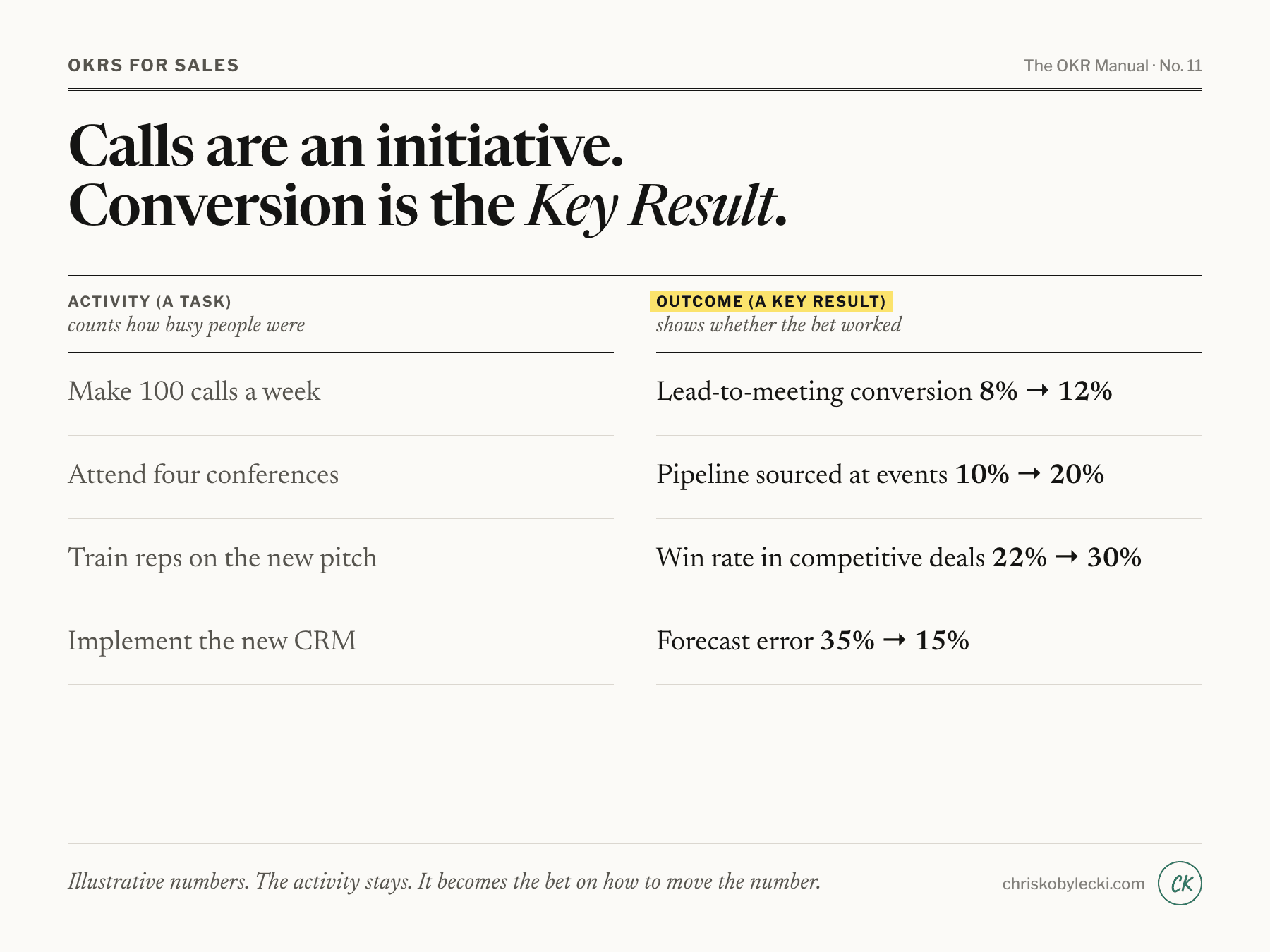
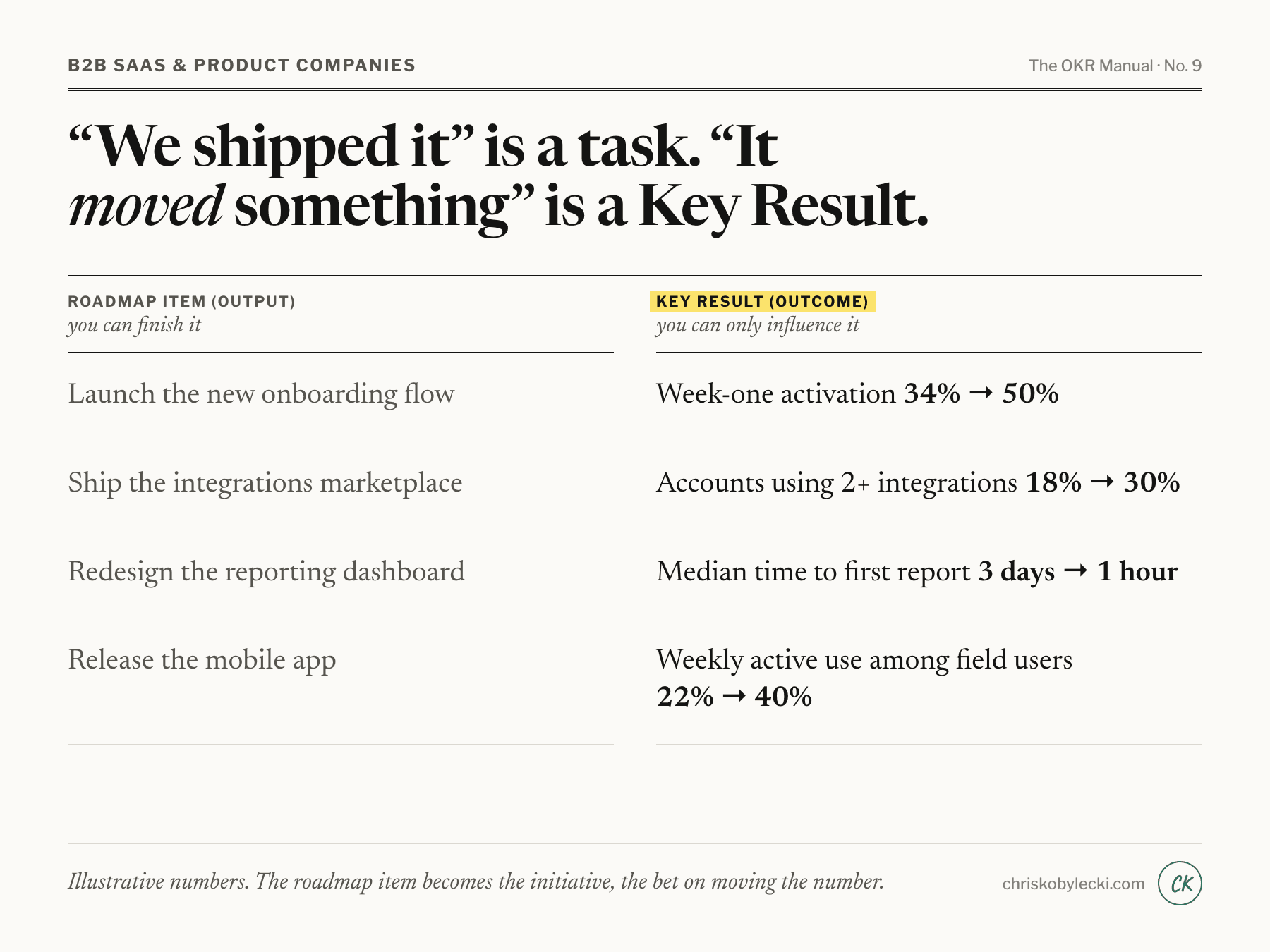
Here is the mistake we see more than any other. Teams write down the work and call it a goal. "Launch the campaign." "Ship the feature." "Make the calls." These are activities. They measure effort, not result, and you can complete every one of them and change nothing about the business.
The fix is to ask, every single time: if we did this, what number would move, and by how much? Then make that the Key Result, and demote the activity to where it belongs.
| Activity-based (what you'll do) | Value-based (what will change) |
|---|---|
| Create an employee engagement program | Improve engagement score from 62 to 75 |
| Reach out to 100 new leads | Lift lead-to-opportunity conversion from 8% to 15% |
| Launch the new website | Raise demo bookings from 1.5% to 3% of visitors |
| Run five customer interviews | Cut time-to-value from 21 days to 10 |
| Ship version 2.0 | Move 30-day retention from 40% to 55% |
Read the left column again. Every item can be finished on time, in full, while the business stays exactly where it was. You can run 100 calls and close nothing. That is the trap: mistaking the means for the objective.
Think of it as driving to Lisbon. "Drive 500 kilometres" is an activity. You can do all 500 and end up in the wrong city. "Arrive in Lisbon" is the outcome. The kilometres are just one route among several, and if a shorter one appears, you take it. Your Key Results should describe Lisbon, not the odometer.
The live teardown
Enough principle. Let's take a bad OKR, the kind we see in real drafts, and fix it on the page.
The original:
Objective: Significantly improve sales and become a market leader. KR 1: Reach out to 100 new leads. KR 2: Implement a new CRM. KR 3: Increase revenue.
Every failure mode is here. The Objective has a metric bolted on and still says nothing. Two of the three "KRs" are activities. The third has no start and no target. Watch it come apart and go back together.
Step 1: rescue the Objective. Strip the metric, find the real ambition, make it one breath. Become a market leader is a wish, not a direction. What change is underneath it? The team wants sales to stop depending on the founder chasing every deal. So: "Build a sales engine that doesn't run on heroics." Simple, no number, and you can picture it.
Step 2: name what would actually move. If that engine were real, which numbers would prove it? Conversion would rise, the cycle would shorten, pipeline would stop depending on one person. Three measurements, named before we write a single KR.
Step 3: turn each measurement into a Key Result, X to Y.
KR 1: Lift lead-to-opportunity conversion from 8% to 15%. KR 2: Cut average sales cycle from 90 days to 60. KR 3: Grow qualified pipeline coverage from 2x to 3.5x quota.
Each one is an outcome, each has a start and a target, and together they grade the Objective honestly.
Step 4: the activities don't disappear, they move. "Reach out to 100 leads" and "implement a new CRM" were never goals. They are initiatives, the bets you make to move the numbers above. Keep them on a separate list, because if the CRM goes in and conversion doesn't move, the initiative failed and the Key Result still tells the truth. Confusing the two is how teams congratulate themselves for installing software while the business stands still.
That is the method, and it works on any bad OKR you'll ever be handed.
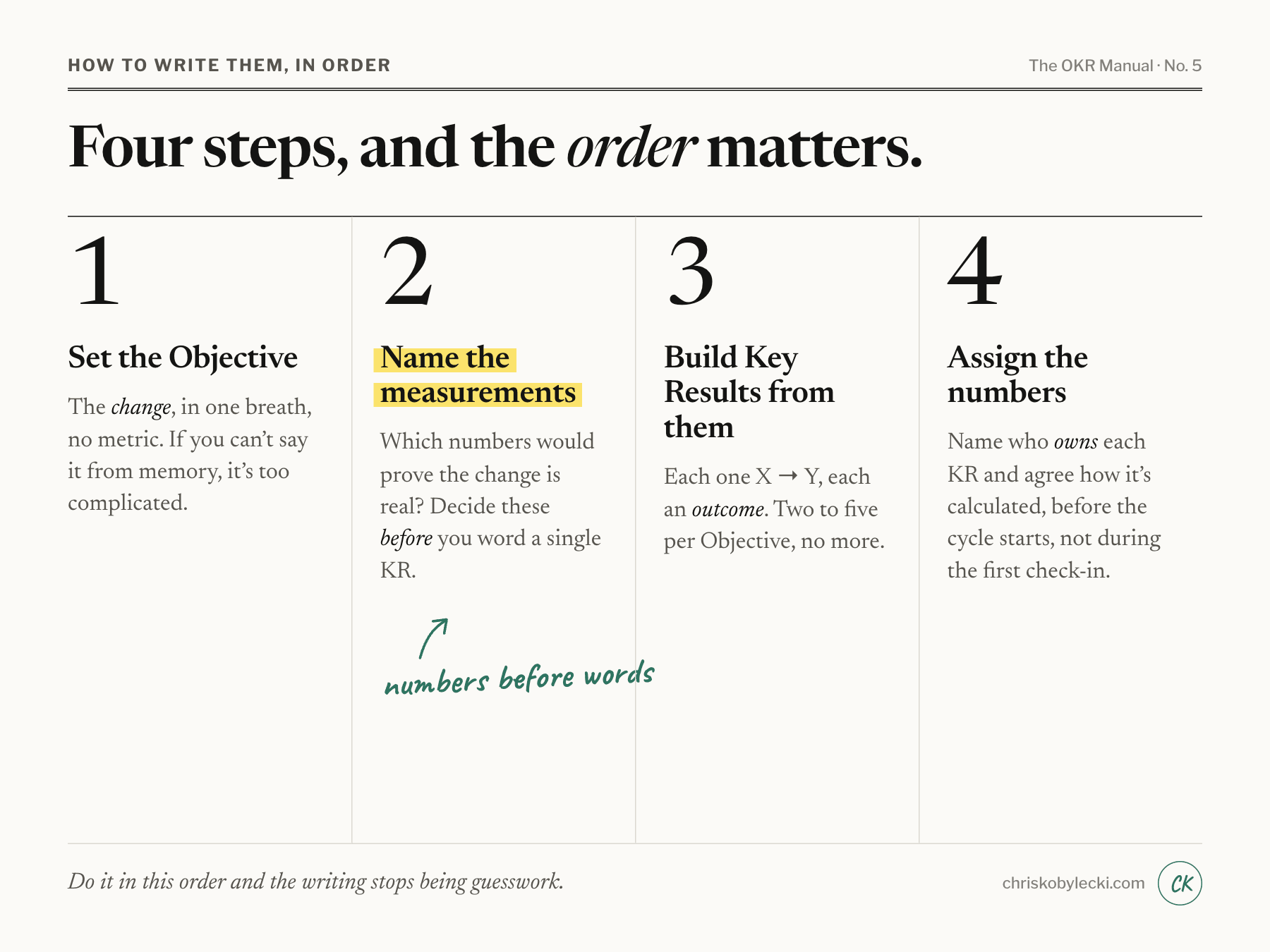
The process, in four steps
The teardown wasn't improvised. It followed the order we use every time:
- Set the Objective. The change, in one breath, no metric.
- Name the measurements. What numbers would prove the change is real? Decide these before you word anything.
- Build Key Results from the measurements. Each one X to Y, each an outcome.
- Assign the numbers. For every KR, name who owns it and agree exactly how it's calculated, before the cycle starts, not during the first check-in (Article 3's clarity-of-numbers problem, solved in advance).
Do it in that order and the writing stops being guesswork.
Focus
A rule of thumb that has survived every engagement we've run: one to three Objectives, two to five Key Results each. Not because the numbers are magic, but because that is roughly the limit of what a team can actually hold in focus for a quarter.
Seven Objectives with ten KRs apiece is seventy priorities, which is to say none, and it guarantees the focus an OKR needs will be spread too thin to move anything. Writing good OKRs is mostly an act of subtraction. The hard sentence in the room is "what are we willing to not do this quarter?", not "what should we chase?" Saying no is the skill. The template just records the decision.
Common mistakes to scrub before you commit
Before you call a draft done, check it against the usual suspects:
- A metric in the Objective. Move it down to a KR.
- Activities wearing KR clothing. "Launch", "ship", "run", "create". Ask what number they move and rewrite.
- A KR with no starting value. X to Y, always. No X means no proof.
- A number that was never going to move. That's a KPI you're maintaining, not a change you're making.
- Too many of everything. If you can't recite your Objectives from memory, the team can't either.
The takeaway
Objectives set the destination in one breath, no metric. Key Results prove you're getting there, from X to Y, measuring outcome rather than effort. Activities are real and necessary, but they are initiatives, not goals, and keeping that line clean is most of the discipline. Write few of them, own the numbers, and say no to everything else.
None of this is hard to understand. It is hard to do, because doing it forces the decisions most teams write OKRs to avoid. OKRs surface problems; they don't solve them, and the first problem a well-written one surfaces is usually an argument about what actually matters. That argument is the work. The template is just where it lands.
Next: the operating rhythm. A perfectly written OKR still dies without the cycle around it, the check-ins, the grading, the retro. That is where most implementations really go, and it's Article 6.