OKRs · The OKR Manual, No. 10
OKRs for VC & PE Firms and Their Portfolios
A fund owns stakes in businesses that each define their numbers differently. How to line up a portfolio on a few outcomes without sending a template.

A fund has a problem no single company has. It owns a stake in several businesses, each with its own leadership team, its own numbers and its own opinion of what matters. The board wants predictable execution. The portfolio wants focus. And somebody has to decide whether the same OKR approach goes into all of them.
It can. It is also one of the easiest places to turn a useful tool into a compliance exercise.
The situation
Take a platform or fund with five to ten operating companies. Board packs arrive in five formats. Revenue is defined four ways. One company is hitting its plan, one is missing it for reasons nobody has named, and the partner responsible for both has an hour per month for each.
The wish is reasonable: line up the portfolio on a few outcomes that matter and see problems early. The risk is that the platform does that by sending a template.
Two levels, two owners
The cleanest way to think about it is that there are two levels of OKRs and they have different authors.
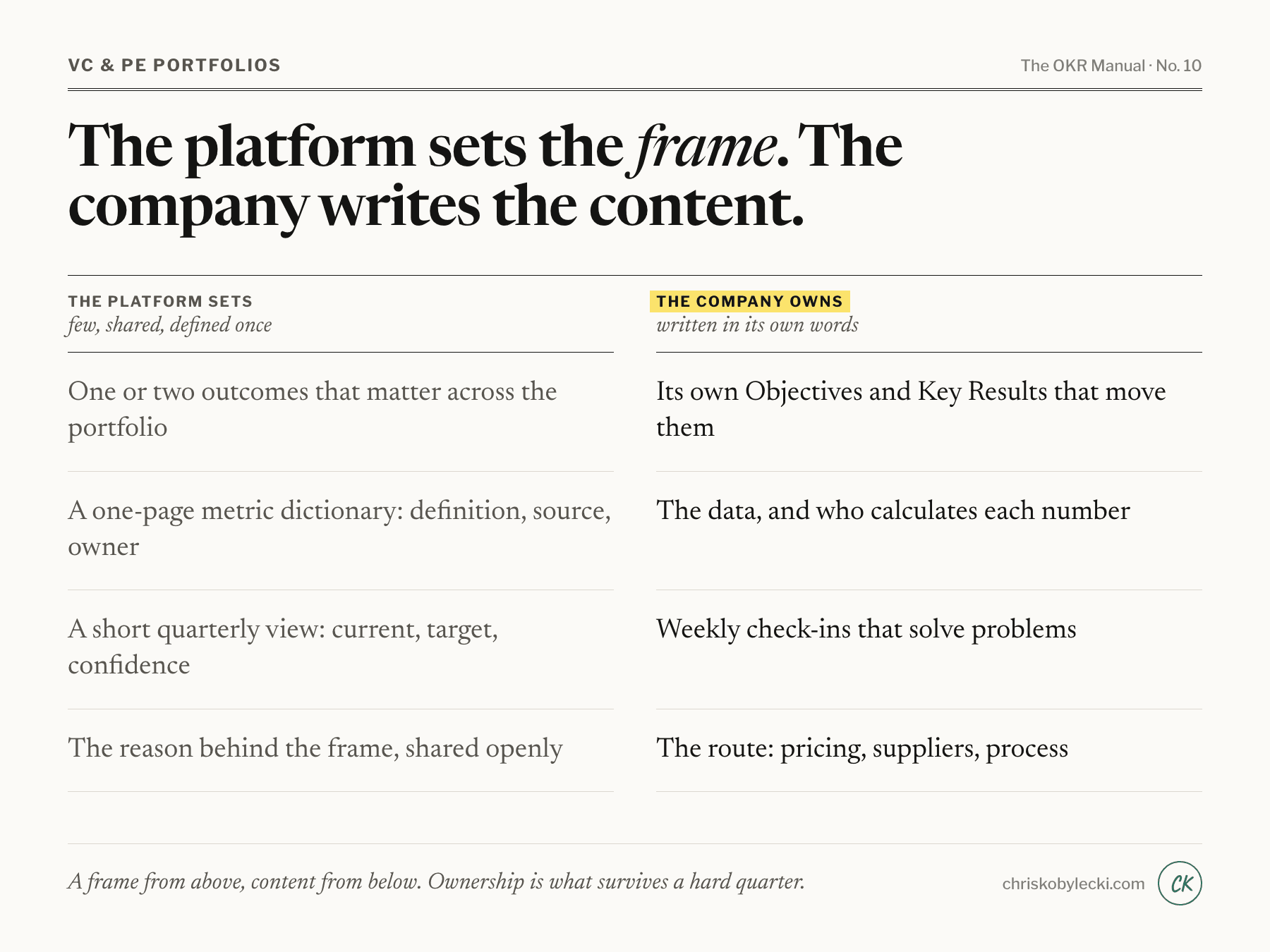
The platform level sets the frame. One or two outcomes that matter across the portfolio, such as profitability or cash conversion. These are few on purpose. Their job is to say what the platform cares about and give every company a common reference.
The company level belongs to the portfolio company's leadership team. They write their own Objectives and Key Results, in their own words, aimed at moving the platform outcomes in a way that fits their business. A logistics company and a software company will not reach higher margin by the same route.
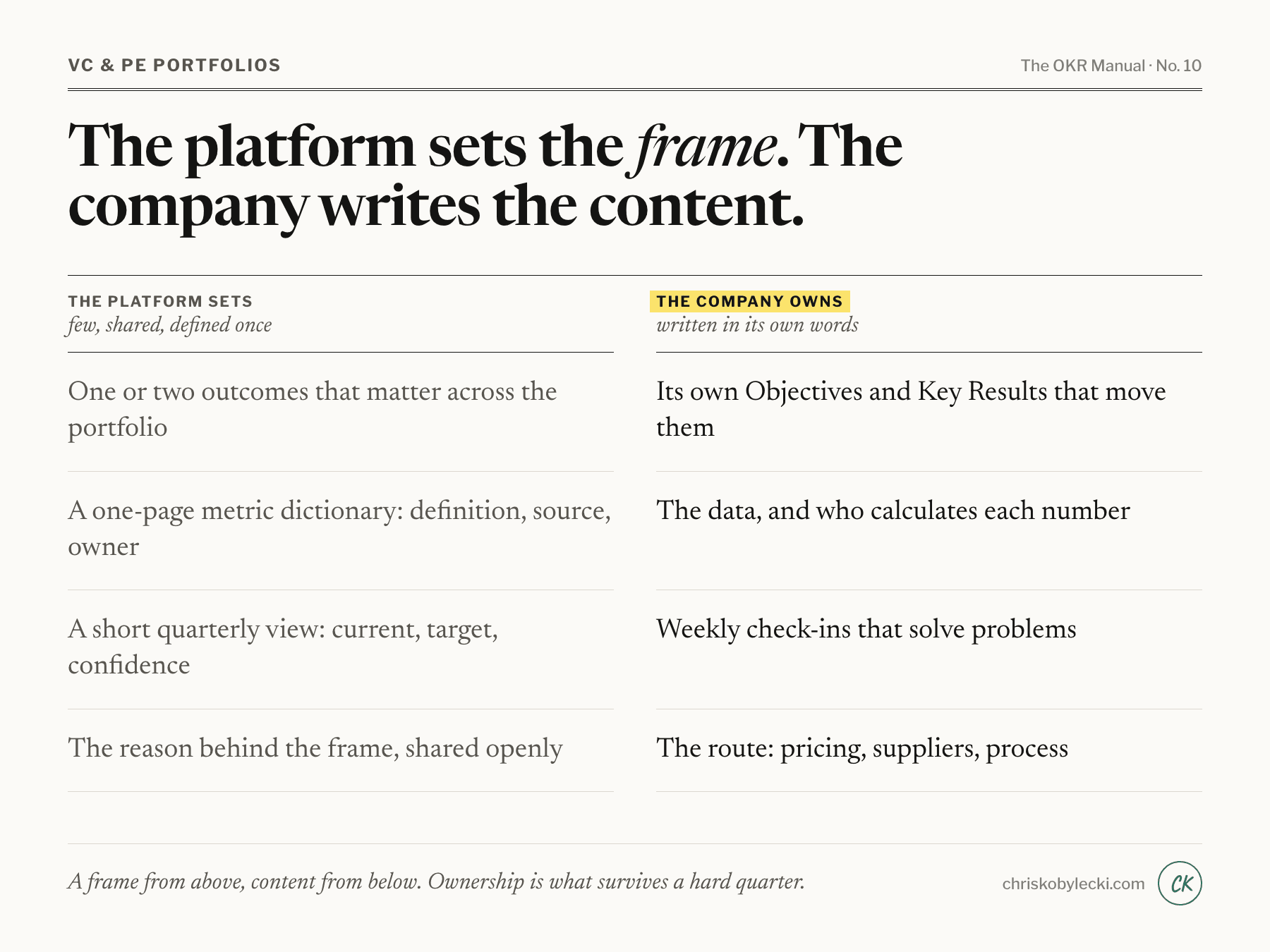
The frame is set from above. The content is written from below. When it works, the company's leaders can explain why each Key Result exists without referring to the fund.
The buy-in trap
This is Article 2's third reason, and it bites hardest here. If the platform hands a company a finished OKR set, the leadership team complies. Compliance looks like green slides and a check-in nobody prepares for, and it ends the first time the quarter gets busy.
Facilitation is slower and works better. The platform shares the frame and the reason behind it. The company's leaders write their version. The platform reads it, asks questions, and challenges numbers it does not believe. Then the company owns it. Ownership is the only thing that survives a hard quarter.
An example (illustrative numbers)
Platform objective: Reach group profitability
- KR1: Group EBITDA margin from 8% → 12%
- KR2: Non-people operating costs from 22% → 19% of revenue
- KR3: Average month-end close across companies from 12 days → 5 days
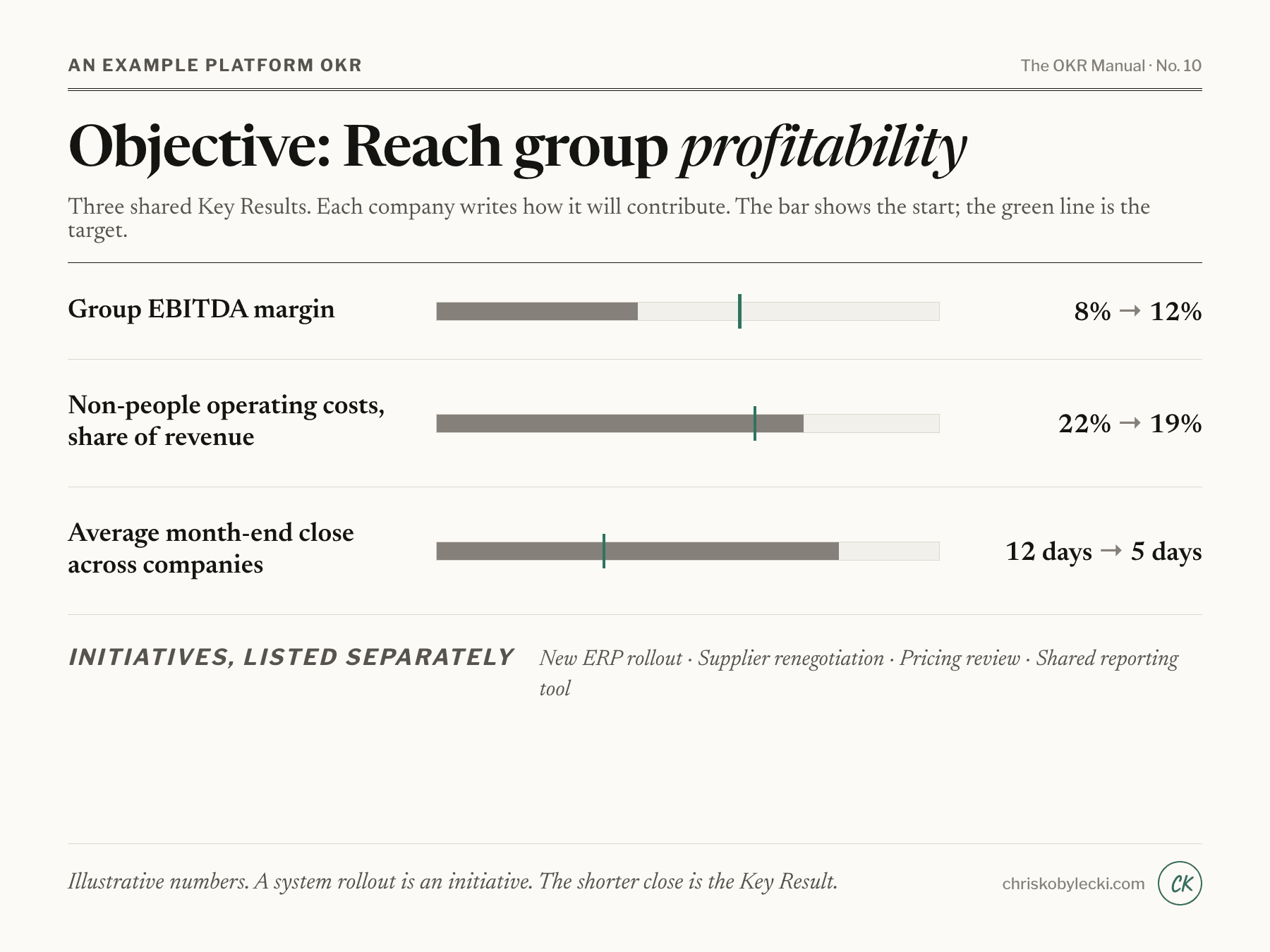
Each company then writes how it will contribute. One may attack pricing. Another may renegotiate suppliers. A third may find that its close takes 12 days because three people reconcile the same ledger by hand. Different routes, same three platform numbers.
Clarity of numbers matters most here
Article 2's reason 7 gets sharper with many companies. If "EBITDA margin" means one thing in company A and another in company B, a group figure is arithmetic on things that don't match.
Before the quarter starts, write a one-page metric dictionary. For each platform number: the exact definition, the data source, who calculates it, and when. Keep it short. The page matters more than the dashboard built on top of it, and writing it usually reveals disagreements that have been quietly distorting the board pack for a long time.
Rollouts are initiatives, not Key Results
A common move in a portfolio is a shared system rollout: one ERP, one reporting tool, one HR platform across all companies. It consumes real effort, and it is tempting to write "roll out the new ERP to six companies" as a Key Result, because it is concrete and everyone agrees it is important.
It is an initiative. The outcome you want from it is something else: a shorter close, fewer manual reconciliations, a forecast you can trust. Write the outcome as the Key Result (close time from 12 days → 5 days) and let the rollout be one of the ways to get there. Otherwise a company can finish the rollout on time, tick the box, and see no change in the number the platform cares about.
What the board sees
Resist the urge to send the board every Key Result from every company. What helps a board is a short view: for each company, its handful of platform-linked numbers, current value, target, and a confidence rating from the people running it. Red, with an explanation and an ask, is a more useful input than an all-green page.
That only works if red is safe. If a company's leaders learn that a red Key Result brings a hard conversation and no help, they will stop reporting red. The platform's behavior in the first red conversation sets the tone for the whole system.
Where it goes wrong
Top-down imposition. The platform writes everything. The companies comply and nothing changes.
Comparing companies on different definitions. Two margins that are not the same margin, set side by side. See the metric dictionary above.
Rewarding green. If the portfolio's incentives favor hitting targets over surfacing problems, expect sandbagged targets and well-timed optimism.
Too many shared numbers. Five platform outcomes across eight companies is forty things to track. Two or three is enough.
Where I would start
Choose one outcome every company can move. Write the metric dictionary for it. Ask each leadership team to draft its own OKRs against it, and spend the first conversation on their questions, not on the numbers. Run one quarter, hold a retro together, and adjust the frame before adding anything.
What it surfaces
OKRs surface problems; they don't solve them. Across a portfolio, the problem they surface first is usually that the companies were never measured the same way, and nobody knew it. That discovery is not a failure of the OKR process. It is the first thing the process was meant to find.
Next, we move from segments to functions, starting with sales.