OKRs · The OKR Manual, No. 1
What Are OKRs (And What They're Not)
Ask ten people around a leadership table and you will get ten answers. One test settles it: strategy only counts when it becomes behavior.

Everyone talks about OKRs. Almost nobody agrees on what they actually are.
Ask ten people around a leadership table and you'll get ten answers. Some think it's strategy. Some think it's a to-do list with a fancier name. Some think it's the thing they update in a tool on Friday afternoons so the CEO stops asking.
I have one test for all of it. Strategy that stays on a slide isn't strategy yet. It only counts when it becomes behavior. OKRs are one of the tools that make that happen. So before we go anywhere in this manual, let's agree on what they are, and, just as important, what they're not.
OKRs are a tool for goal setting and execution
That's it: a tool, not a strategy or a religion.
A good tool does a specific job. OKRs do six:
- Push the organization forward and initiate change.
- Define your priorities and write them down as goals.
- Align your goals with other people and teams.
- Monitor progress.
- Measure success.
- Connect the daily tasks and projects to the company's strategy and long-term vision.
Notice what's on that list and what isn't. OKRs are about change and direction. They are not about running the machine you already have. We'll come back to that distinction, because it's the one that trips up most companies.
The three building blocks
When you focus on value, you have to separate the OKR from the work you do to get there. That leaves you with three components. Keep them straight and half your problems disappear.
Objective: "Where do I want to go?" The outcome you want in the future. Think of it as a destination on a map. It sets the direction. A good Objective is inspirational, understood by everyone, and, this is the part people get wrong, it does not contain a metric. No numbers in the Objective.
Key Result: "How do I know if I'm getting there?" A measurable outcome required to hit the Objective. It's the signpost that tells you how close you are to the destination. Key Results must be ambitious yet realistic, and they must have a start value and a target value (X to Y). If it doesn't have a number, it's not a Key Result.
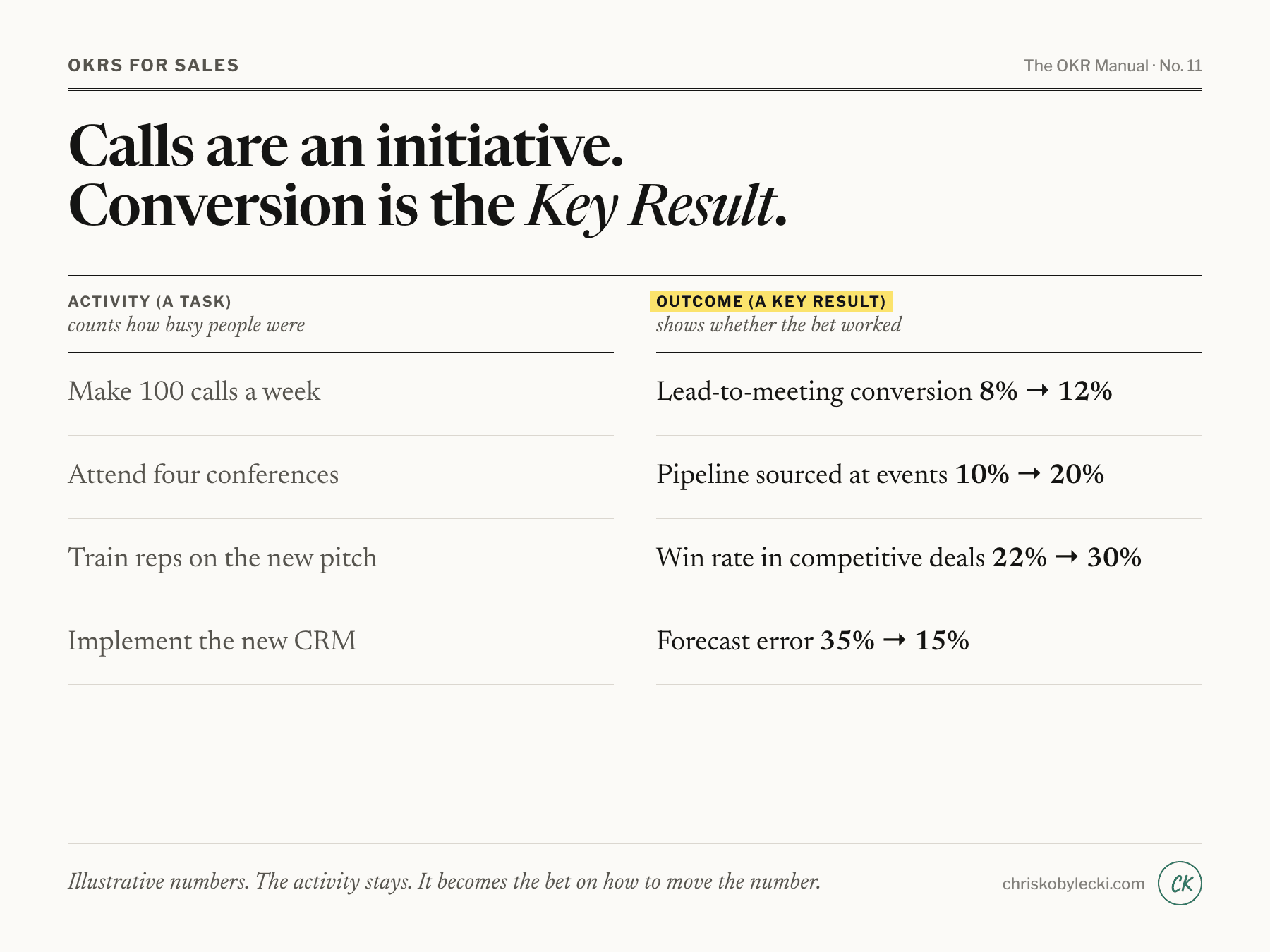
Initiatives: "What will I do to get there?" All the projects, tasks and activities you'll run to move the Key Results. This is how most of us are used to planning: "I'll do this and that."
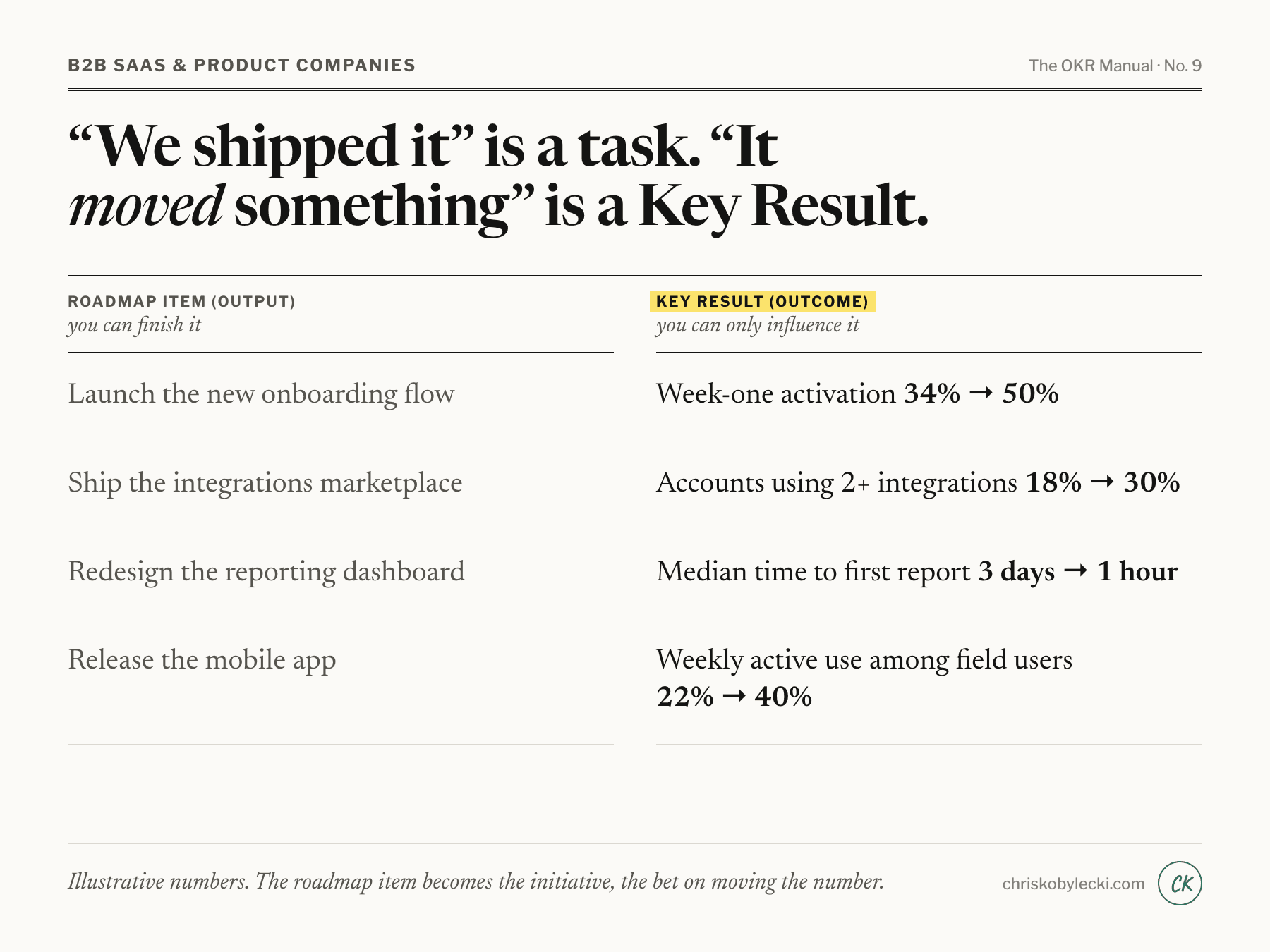
Here's the mindset shift: initiatives are bets. You still track them, because without them nothing moves, but if the numbers aren't improving, the bet was wrong and the initiative has to change. The Objective and the Key Results stay. The initiatives are disposable.
Objective is the destination. Key Result is the signpost. Initiative is the route you're trying. When the route doesn't get you closer, you change the route, not the destination.
What a real one looks like
Enough theory. Here's an actual company-level OKR from one of my sessions:
Objective: Reach group profitability in 2025
- KR1: ~20% EBITDA margin for the existing portfolio
- KR2: Reach existing portco BQR of 44%
- KR3: R&D ratio to 1.0
- KR4: Reduce non-people OPEX by 5%
Look at the Objective. Short, no metric, everyone understands it in one breath. Then look at the Key Results. Every single one has a number. That's the pattern. Inspirational direction on top, hard numbers underneath.
Easy, right?
Well, writing them is easy. Writing good ones, and turning them into behavior your team shows on Monday, is where it gets hard. That's what the rest of this manual is for.
Now the part everyone skips: where OKRs actually fit
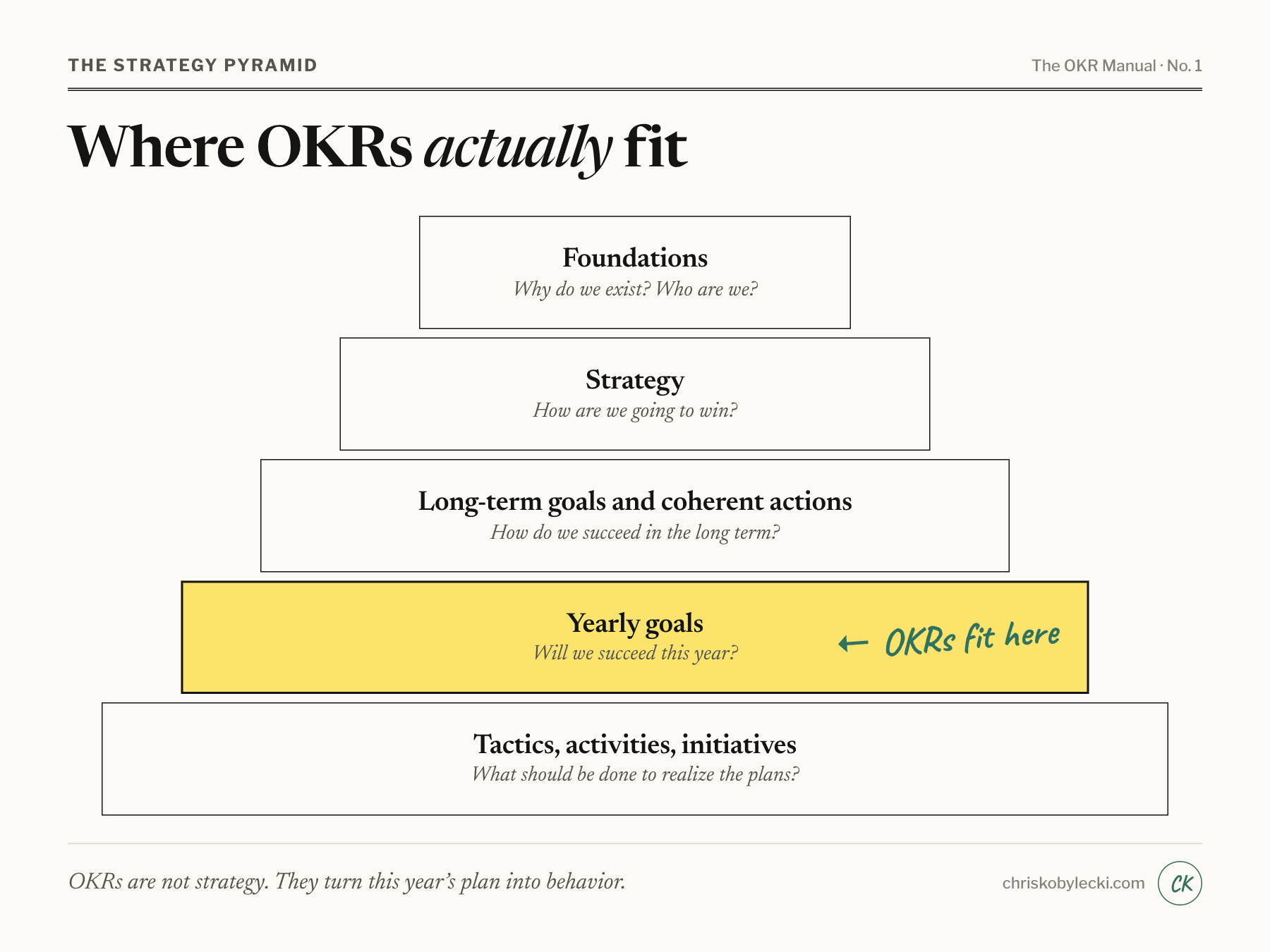
OKRs do not live on their own. They are one layer in a larger framework. Get the layers wrong and OKRs will make things worse, not just fail.
From the top down:
Foundations: "Why do we exist? Who are we?" Mission, vision, values. The basics. If you don't have these, OKRs will escalate the problem rather than fix it, because suddenly a team is forced to rely on a long-term direction that was never defined.
Strategy: "How are we going to win?" Strategy is a set of choices. It defines where and how you're going to play the game to maximize your chances of winning and minimize the chances of losing. (This is the kernel of good strategy from Rumelt's Good Strategy Bad Strategy: a critical challenge, a diagnosis of current reality, a guiding policy, and coherent actions.)
Long-Term Goals / Coherent Actions: "How do we succeed in the long term?" Your long game. Your BHAG, your North Star, your sense of direction, and actions that support it.
Yearly Goals: "Will we succeed this year?" This is what's actually called strategic planning, not strategy. Producing plans. And there are many tools for it: OKRs, MBO, 4DX, Balanced Scorecard, SMART goals, V2MOM. OKRs are one of them.
Tactics / Activities / Initiatives: "What should be done to realize the plans?" The actual work.
OKRs are assumed to be strategy, but they're not. They sit down near the bottom, at the yearly-goals-into-execution layer. They connect this year's plans to the daily work, so the plan turns into behavior instead of staying in a document. They rely on everything above them already existing.
If someone hands you OKRs and expects them to answer "how do we win?", they've put the tool in the wrong slot.
The shift OKRs are supposed to create
Done right, OKRs move a team from the left column to the right:
| From | To |
|---|---|
| Too many competing priorities | 3–5 priorities the whole team can name |
| Strategy lives in a document | Strategy shows up in Monday's decisions |
| Accountability sits with the board | Ownership distributed across the team |
If your OKRs aren't moving you rightward, they're theater. Which brings us to what they're not.
So, what OKRs are not
- Not your strategy. They execute strategy; they don't create it.
- Not a replacement for foundations. No mission/vision/values? Fix that first.
- Not a to-do list. A pile of tasks with a metric bolted on is not an OKR.
- Not for running business-as-usual. Keeping the lights on is a job for KPIs and targets. OKRs are for the change you want to bring.
- Not a magic bullet. OKRs surface problems; they don't solve them. They make the hard conversations unavoidable. The solving is still your team's job.
The takeaway
OKRs are a tool for goal setting and execution, built from three parts: an inspirational Objective with no metric, measurable Key Results that go from X to Y, and disposable Initiatives that are just bets. They live near the bottom of a bigger stack (Foundations, Strategy, Long-Term Goals) and they only work when those layers already exist. Get them right and strategy stops being a slide and starts being behavior.
Get that mental model right and everything else in this manual will click.
In the next article we'll do the hard part: the 11 reasons OKRs fail, and how to avoid every one of them.