The Work Beneath the Work
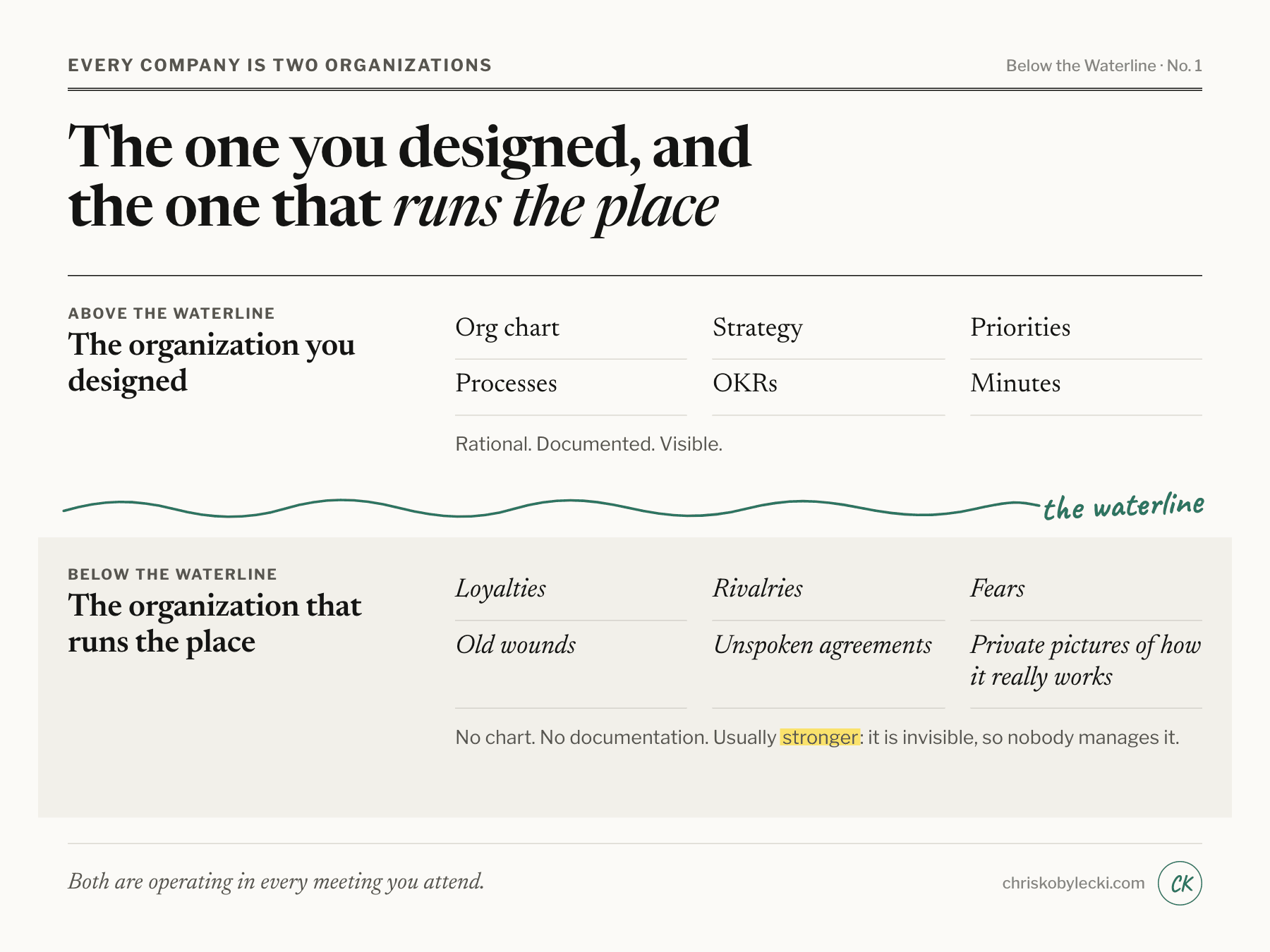
Every company does three kinds of work. The one nobody writes down is the feeling the work produces, and it decides whether the other two get done.

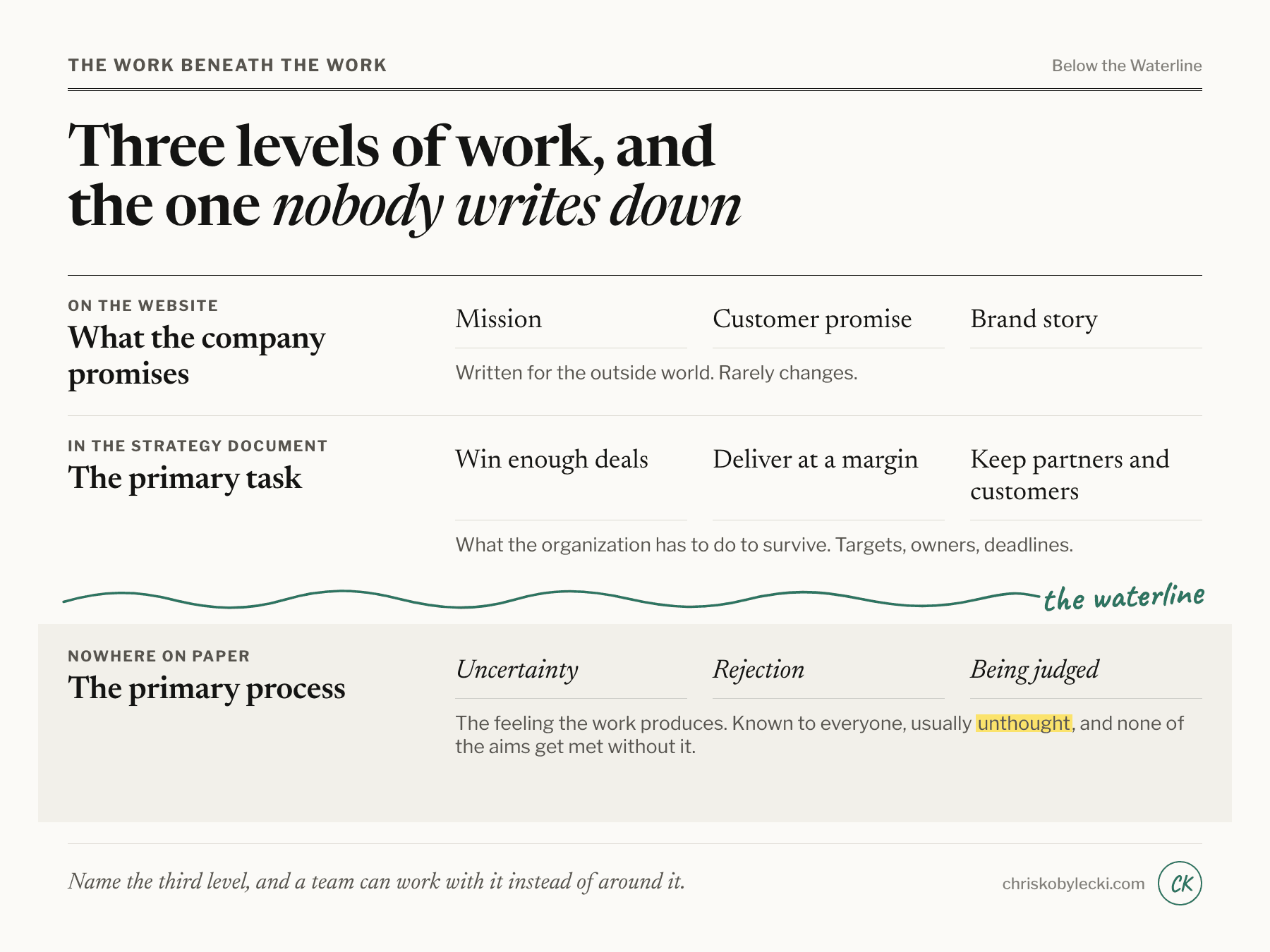
Every organization does its work on three levels.
The first is the one on the website: what the company promises its customers. It is written for the outside world and rarely changes.
The second is the primary task: the work the organization has to do to survive. Win enough deals, deliver them at a margin, keep the partners and customers who pay the bills. This is what lands in a strategy document, with targets, owners and deadlines.
The third never makes it into either. It is the emotional experience that doing the work produces in the people who do it, and it runs through the whole organization whether anyone names it or not. In the Tavistock tradition of organizational consulting, this is called the primary process. It is separate from the organization's aims, and none of those aims can be achieved without it.
What the primary process looks like
I worked with a software integrator that was going through two changes at once. Its main software partner had changed the rules of the game: how the integrator was allowed to sell the partner's product. At the same time, the company had been acquired, and the acquisition brought its own wave of changes.
The anxiety in the leadership room built up over time, and it kept everyone from delivering. Nobody called it anxiety. As soon as we named it and talked about it openly, the team started to move forward again.
That anxiety came from the work itself. An integrator's business rests on rules set by a partner it does not control, so uncertainty is part of the raw material it works with every day. In systems language, it is the throughput. The partner's new rules and the acquisition made that uncertainty impossible to ignore, and the leadership room was one of the places it surfaced.
Every organization has its own version. A sales team works with rejection. A young company works with uncertainty about whether it will exist next year. An agency works with being judged by every client. Treat these as guesses to test, but they point at the useful question: beyond the product, what does doing this work feel like, everywhere in the organization?
Coping or managing
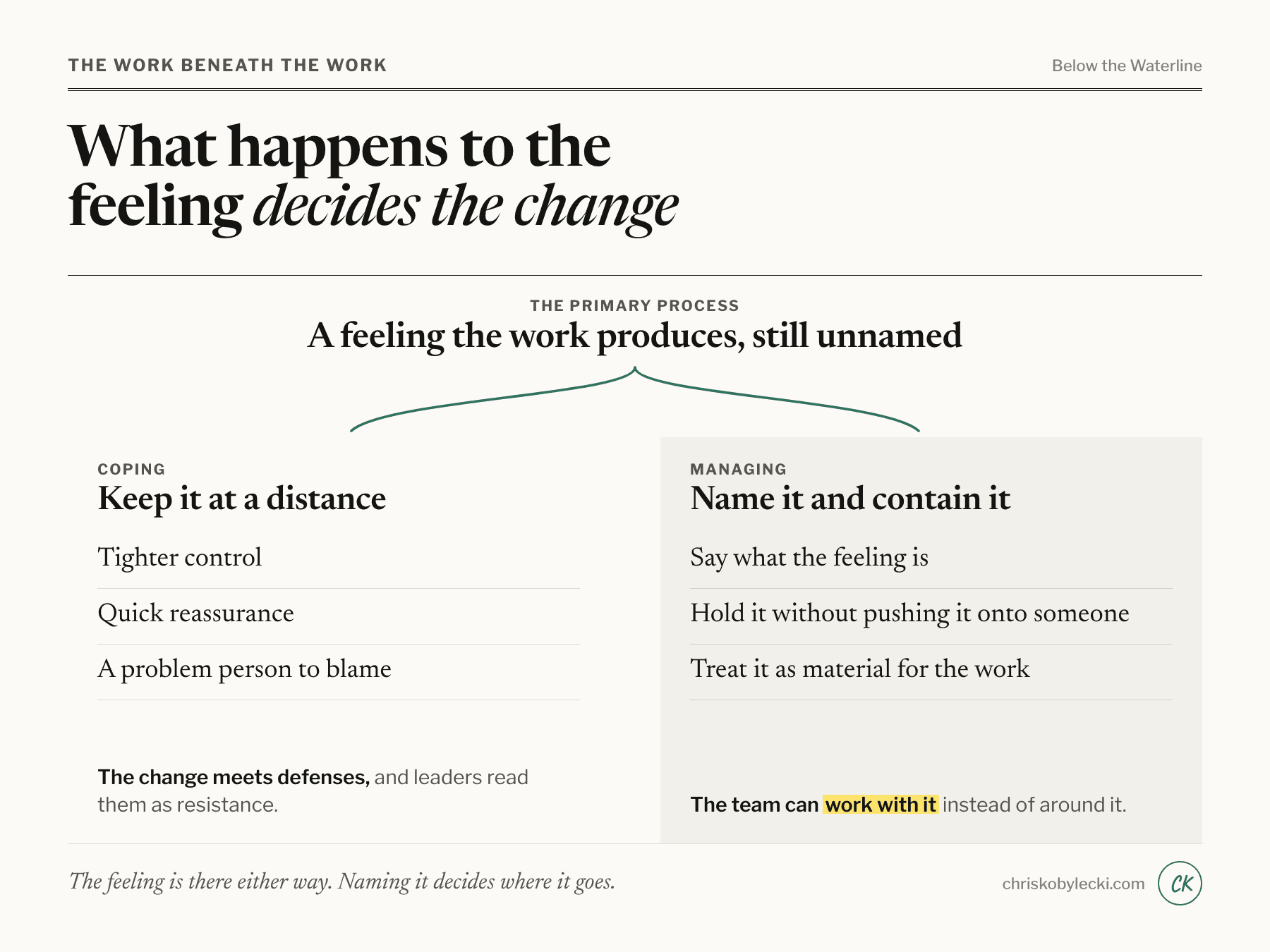
What happens to that feeling decides a lot. When it stays unnamed, people at every level end up coping with it instead of managing it. Coping means defenses: personal and institutional habits that keep the feeling at a distance, such as tighter control, quick reassurance, or a problem person to blame.
This is also where a lot of resistance to change comes from. A change often asks people to carry more of the primary process than before: more uncertainty, more exposure. When nobody says so, the change meets defenses, and leaders read those defenses as resistance.
The way through is to contain the feeling rather than control it or push it onto someone else. That only works once the feeling counts as material for the work and stops being filed as a hazard of the job.
Known, but never thought
In organizational consulting and organization development, the primary process often shows up as the unthought known. The organization knows it. People live it every day, feel it and act on it. Nobody has put it into words.
It stays unthought for ordinary reasons. It is too close and too familiar to notice. It gets pinned on particular people or roles: the lonely CEO, the hostile manager, the team that keeps calling in sick. Or it is buried under defenses that run across the whole organization.
The integrator was a clear case. The leadership team had been avoiding a lot of things, and the anxiety was the thing underneath them, known to everyone in the room and said by no one. Once we named the anxiety, the team could work with it instead of around it.
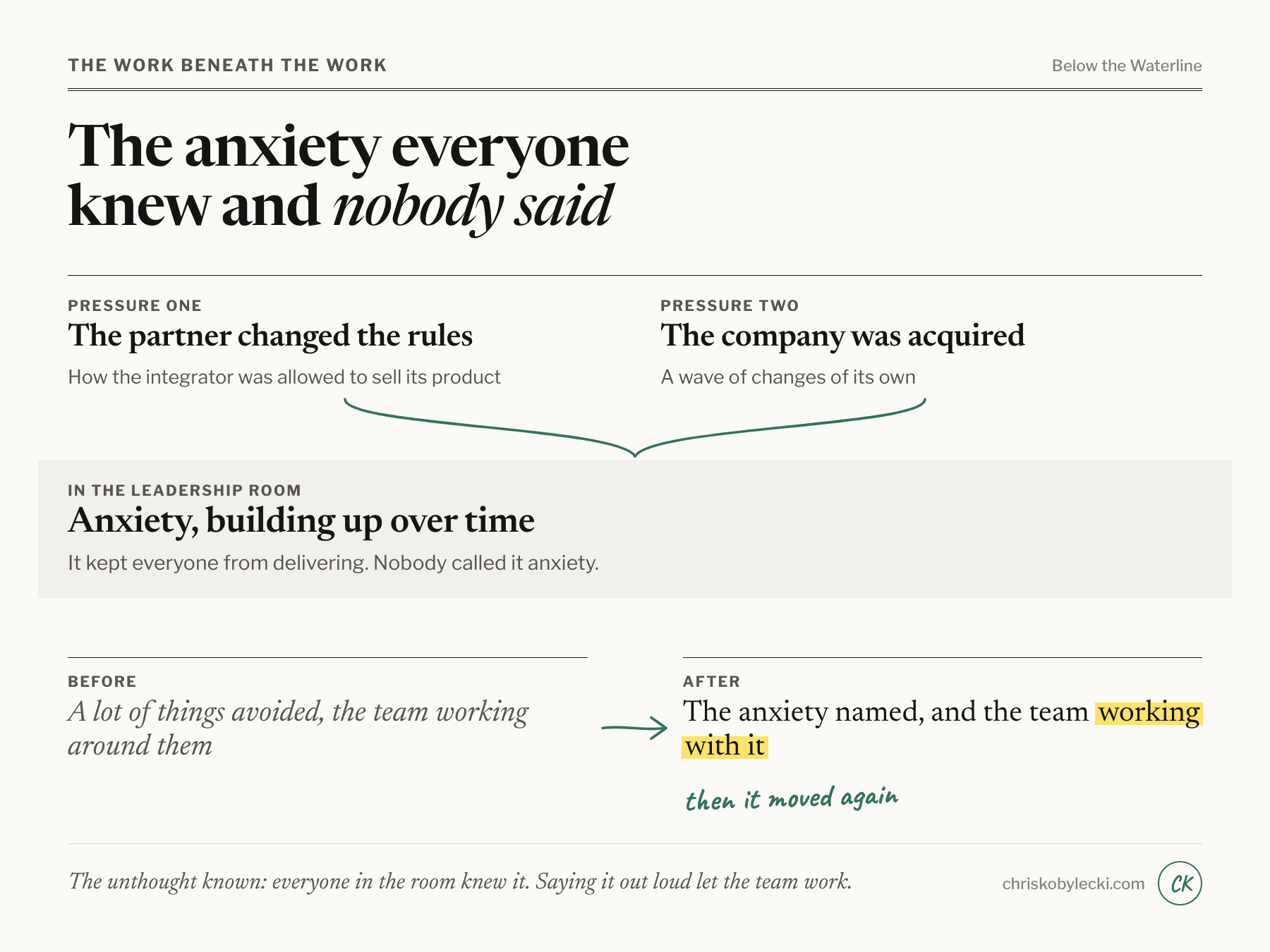
Putting it into words does not make the work easier, and it does not tell anyone what to do. The dilemmas stay as sharp as before. What changes is the meaning. Once the feeling has a name, decisions about risk, goals and communication can be thought through with it in view, and that sets a new agenda.
Emotion as a lifeline
Behind all this sits a view of emotion that runs against how most companies treat it. We usually see feelings as private property, held inside one person and best kept out of the work. This tradition sees emotion as a property of relationships and settings. Between two people, it belongs to the pair. In a group, it spreads across the room. An organization gives that shared space a particular shape, through its task, its technology, its territory and its time, and through its history and culture.
So what you feel in your role is often the organization registering in you: an experience of the organization that is in you, but not simply of you. You can own it, deny it, project it onto someone else, or never notice it. You can also use it.
There is a reason to bother beyond better diagnosis. Work that stays at the level of structure, process and change plans can be useful, and it still loses something. The word for what goes missing is passion: contact with what grounds the enterprise and gives it life. The feelings an organization produces are how it stays in touch with what it does and why. Working with them can give some of that passion back.
Asking the question
When a feeling keeps coming back with the job, ask why this system might need someone in your role to feel it. Then check four things:
- Does the same feeling turn up in other roles and at other levels, sometimes disguised as cancellations, sick days or a team everyone calls difficult?
- What raw material does your organization handle beyond the product? Uncertainty, risk, exposure, judgment?
- Where are you coping instead of managing: reassuring too fast, tightening control, deciding one person is the problem?
- Does the change that keeps stalling ask people to carry more of this feeling than they carry now?
Sources
- Armstrong, D. (2005) 'The analytic object in organizational work', in Armstrong, D. and French, R. (ed.) Organization in the Mind: Psychoanalysis, Group Relations and Organizational Consultancy. London: Karnac, pp. 44–54. First published in Free Associations, 11(57), 2004, pp. 79–88.
- Miller, E.J. and Rice, A.K. (1967) Systems of Organization: The Control of Task and Sentient Boundaries. London: Tavistock Publications.
- Bollas, C. (1987) The Shadow of the Object: Psychoanalysis of the Unthought Known. London: Free Association Books.