Below the Waterline · No. 2
Feelings Are Data
The flatness in your leadership meeting is not resistance. It is the most accurate reading of the organization you will get this quarter, and it is free.

The reorg was announced on a Thursday, on a call, with good slides. The logic was sound. Nobody argued.
Then, over the following weeks, something happened that never reached a dashboard: the leadership team went flat. Meetings got shorter and politer. Questions stopped. The COO, normally the first to stress-test anything, said "makes sense" twice and looked at his laptop. The CEO noticed, of course. He had a name for it: change resistance. Textbook. It would pass.
Three months later the flatness turned out to have content. Three of the company's best people resigned, all of them quietly, none of them angry. Their exit interviews used strikingly similar words: it wasn't the new structure, exactly. It was that nobody had asked.
The flatness was a reading, not resistance. The most accurate reading of the organization available that quarter, delivered free of charge, to a leadership team trained to ignore it.
The intelligence you already pay for
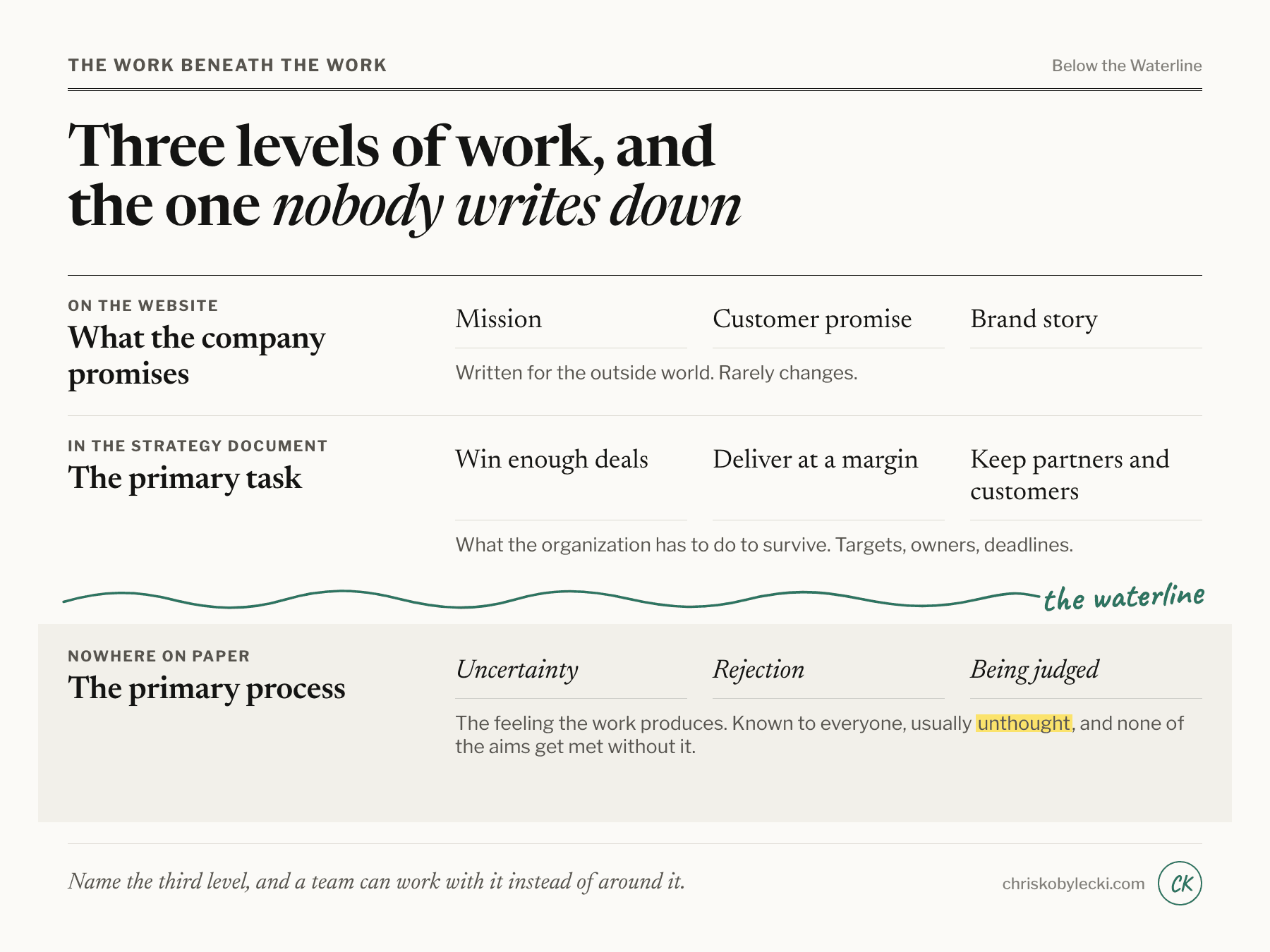
Most companies treat emotion at work in one of two ways: as noise to be managed, or as private property. Someone's frustration is "their stuff". The team's mood is weather. Either way, the feelings are about the people who have them, and the job of a professional is to keep them out of the work.
David Armstrong, who spent decades consulting to organizations from inside the Tavistock tradition, argued in 2004 that this gets it backwards. Emotion in an organization is information about the state of the system, not a disturbance of it. His formulation, in full: the shift we need is "from emotional intelligence to the intelligence (as in 'military intelligence') afforded by emotion". Not skills for managing feelings so work can proceed undisturbed. Feelings as reconnaissance.
His own example: facilitating a strategy day for a mental health trust under heavy market pressure, Armstrong noticed two feelings in himself as the day wore on. An absence of passion in the room, and a sense of loss. He said so, aloud. What surfaced was the real question the strategy documents were avoiding: the organization was weighing the risk to its survival against the risk to its identity, and the missing passion was how that unspoken dilemma felt from inside. No spreadsheet in the room carried that information. The flatness did.
Notice the structure, because it is the same as the reorg story: a feeling, registered and taken seriously, knew something before anyone could say it.
Your reaction is an instrument, not a bias
This idea has a precise origin, and it is older than most management theory.
In 1950 the psychoanalyst Paula Heimann published a short paper that broke a professional taboo. Analysts of her era were trained toward detachment: the good analyst felt nothing beyond a uniform, mild benevolence, and any stronger reaction to a patient was considered a failure of professionalism, something to overcome. Heimann's thesis was that this ideal was not just wrong but wasteful: the analyst's emotional response to the patient "is an instrument of research into the patient's unconscious". What you feel in the room is often the most direct data available about what the other person cannot yet say. She added a warning that survives translation into any boardroom: an analyst who works without consulting their feelings produces poor interpretations.
Replace "analyst" with "leader" and the claim still holds. The discipline Heimann attached to it holds too, and it is the part most worth stealing: sustain the feeling, don't discharge it. Feel the anger; don't send the email. The instrument is only useful while you are reading it rather than obeying it.
Referred pain
Kay Trainor, writing in 2019, gives this a name any manager can use: feelings as data. Her best illustration goes like this.
Leila runs the leadership development arm of a corporate training academy. In the canteen queue, one of her tutors mentions, casually, that his co-tutor has double-booked herself over the final day of a client program, and has already told the client. Leila is instantly furious. She fires off a sharp email demanding a meeting. The reply is unapologetic. She starts typing something angrier, and then stops, because something doesn't add up: these are two of her best tutors, the mistake is unusual, and this level of anger is not like her.
That pause is the method. When she finally sat down with both tutors, the source appeared: several participants on that program had been sent by their managers as a corrective, because they were "difficult". They were angry at being sent. Their anger had worn out the tutors, leaked into a canteen conversation, and arrived in Leila's chest an hour later. Trainor's analogy is referred pain: like the body, a system often feels its pain somewhere other than where it originates. Leila was the fourth stop on that anger's journey. Because she read it as a signal instead of acting on it, the conversation shifted from "who booked what" to what the program's participants actually needed, which was the real problem all along.
How exactly a feeling gets from one person's chest into another's has its own mechanism and its own article later in this series. For now the practical point stands on its own: the feeling that arrives in you did not necessarily start with you.
Trainor's model for using this is a triangle: feeling, thinking, doing. Most managers live on the doing corner, visit thinking, and treat feeling as an off-site. The craft is movement: notice what you feel, stop before acting, ask what it might mean about the system, and only then do something. Two signals tell you a feeling deserves this treatment: it is disproportionate to its trigger, or it is out of character. Leila's anger was both.
The fine print
Not every feeling is a message from the system. Sometimes your irritation is yours: the bad night, the old bruise, the deadline. Usually it is a mix, and people differ in what they tend to pick up. So the claim is not "trust your gut", which is how bad decisions get promoted to values. The claim is narrower and more useful: register the feeling, then think, then act. Data, not instructions.
And the warning that stands over this whole series: if you catch yourself using this idea to diagnose one person, including yourself ("I'm just too sensitive", "she's just angry"), you are probably reading it wrong. Ask what the system is doing that this feeling would be an accurate response to.
Why smart teams keep the gauge covered
Here is the function the dismissal serves, because there always is one.
"Change resistance" is a wonderful diagnosis: it requires nothing of the diagnoser. If the team's flatness is resistance, the reorg stands and the CEO sleeps. If the flatness is data, the CEO has to reopen a decision he was relieved to have closed, and ask a question he might get an answer to. Calling feelings noise is how leadership teams protect their decisions from information.
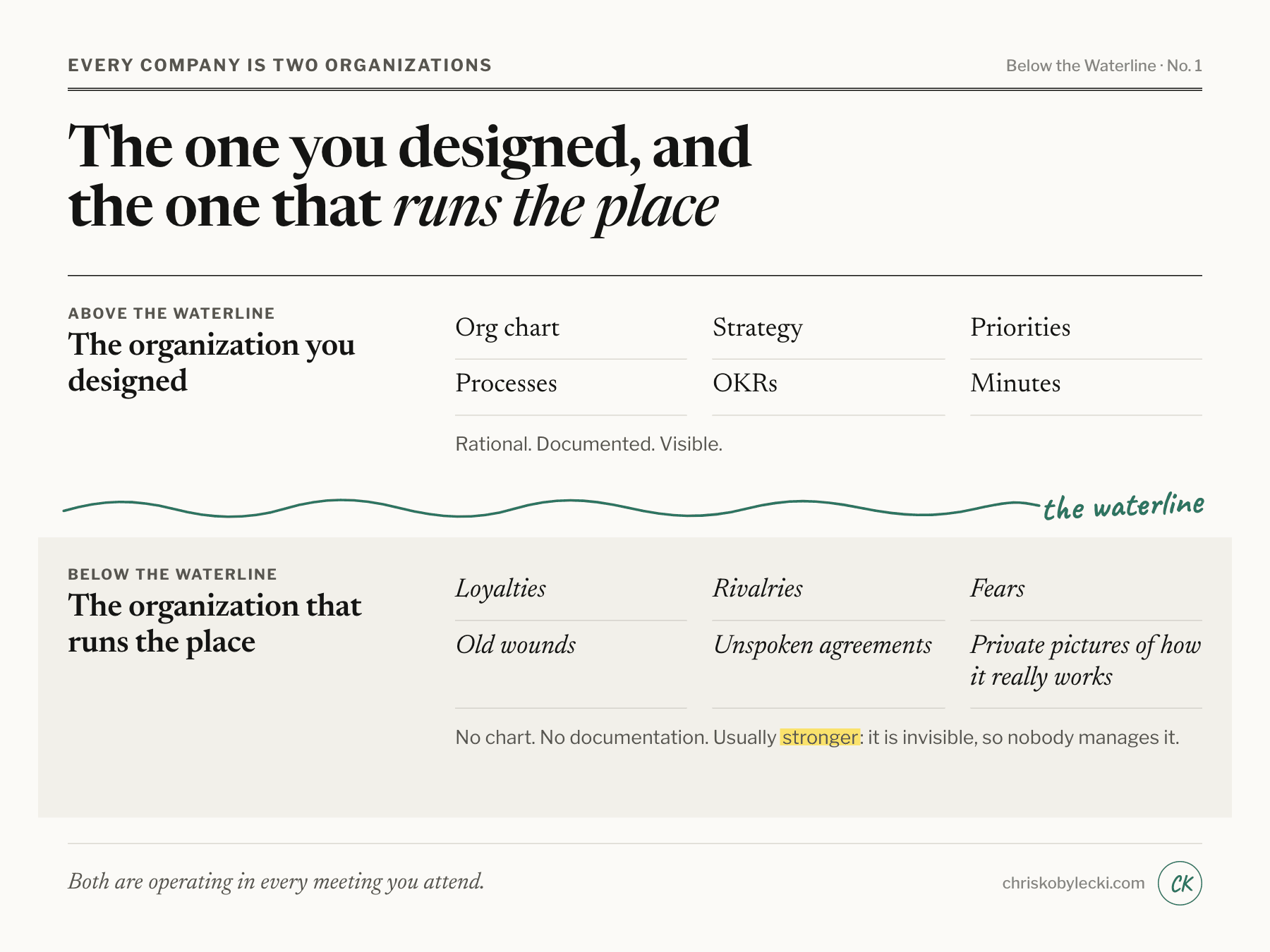
The same goes for the office rule that never dies: "let's leave emotions at the door." As policy, it is pure theater. The emotions attend the meeting anyway; they just stop reporting to you. They show up later, disguised as slipped dates, "alignment issues", sick days, and resignation letters from people who were never once angry in a meeting.
What we see in leadership rooms
We facilitate strategy and OKR work for a living. The room's weather is part of the data set, and it is usually ahead of the dashboard by about a quarter. The energy that drains out of a leadership team at one specific agenda item. The red number that gets discussed in a strangely bright tone. The planning session that produces excellent slides and leaves everyone exhausted in a way the work doesn't explain. In our experience these are the earliest and cheapest reporting the organization produces, not side effects of the real work. The flatness knew about the resignations before the resignations did.
You do not need a consultant to read the gauge. You need the pause.
Spot it on Monday
Three places the data is already arriving this week:
- The meeting that exhausts you disproportionately. One hour with one team costs you more than four hours with another. That difference is information about the team, not about your stamina.
- The topic that always gets deferred. Watch feelings do the scheduling: the item that slides to "next time" for the fourth time is usually the one carrying the most anxiety, which is exactly why it never fits the agenda.
- The joke that lands too hard. The laugh that is a little too loud, about the same thing, twice. Jokes are how truth gets into rooms that don't let it through the door.
One move: the next time a feeling in a meeting is disproportionate or out of character, yours or the room's, do neither of the easy things. Don't act on it, don't dismiss it. Write one sentence: "What might this be telling us about the system?" Then bring the sentence, not the feeling, to the next conversation.
Sources
- Armstrong, D. (2004) 'Emotions in organizations: disturbance or intelligence?', in Huffington, C., Armstrong, D., Halton, W., Hoyle, L. and Pooley, J. (eds) Working Below the Surface: The Emotional Life of Contemporary Organizations. London: Karnac.
- Trainor, K. (2019) 'Feelings as data', in Obholzer, A. and Roberts, V.Z. (eds) The Unconscious at Work: A Tavistock Approach to Making Sense of Organizational Life, 2nd edn. London: Routledge, pp. 196–204.
- Heimann, P. (1950) 'On counter-transference', International Journal of Psycho-Analysis, 31, pp. 81–84.