Below the Waterline · No. 1
Below the Waterline: The Other Organization You Run
Every company is two organizations. The one on the chart makes the decisions. The one below the waterline decides whether they happen.

The decision was made on a Tuesday. Everyone was in the room. The options were on the slide, the trade-offs were discussed, the CEO summarized, heads nodded, someone wrote it in the minutes. Clean.
Two weeks later the decision has quietly un-made itself. Nobody reversed it. There was no meeting where anyone said "let's not". The teams just kept doing what they were doing before, the exceptions multiplied, and by the next leadership meeting the topic was back on the agenda wearing a different name.
If you lead a company, you have watched this happen. Probably this quarter.
Here is the explanation: the decision was made in one organization and executed in another.
Every company is two organizations
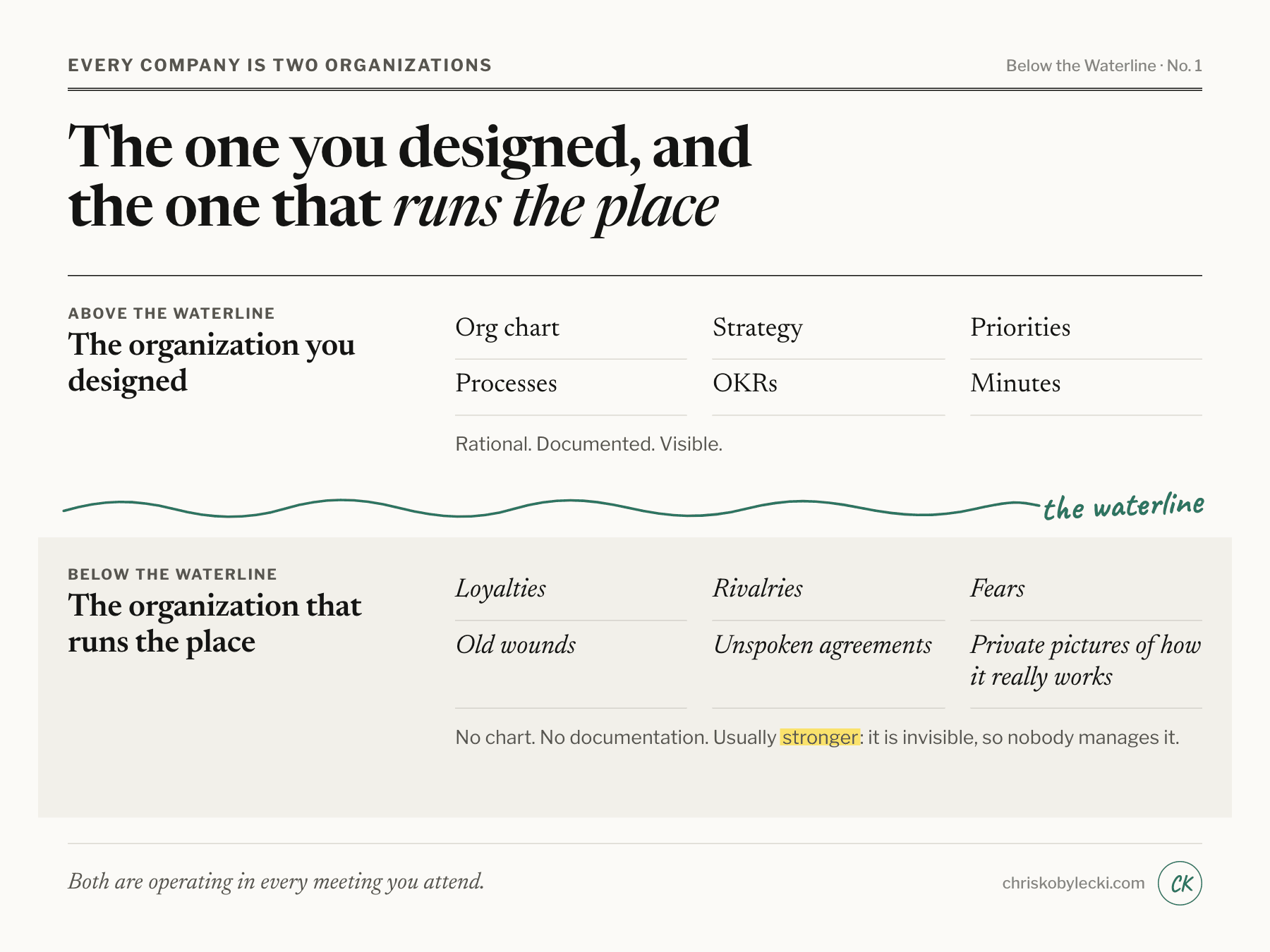
There is the organization you designed. It has an org chart, a strategy, priorities, processes, maybe OKRs. It is rational, documented, and visible. Call it the organization above the waterline.
And there is the organization that actually runs the place. It is made of loyalties, rivalries, fears, old wounds, unspoken agreements, and private pictures of "how things really work here". It has no chart and no documentation. It is the organization below the waterline.
Both are real. Both are operating in every meeting you attend. The one below the waterline is usually stronger, for a simple reason: it is invisible, so nobody manages it.
The idea comes from a 75-year research tradition, running from post-war studies of coal mines and hospitals to today's work on why change programs fail. We are studying that tradition formally at the Tavistock in London, the institute where much of it was written, and testing it weekly in real leadership teams. This series translates it into the language of people who run companies. No couch required.
The picture in your head is not the picture in theirs
Start with the simplest finding, from Jean Hutton, John Bazalgette and Bruce Reed of the Grubb Institute. They spent decades helping executives untangle exactly the kind of un-made decision described above, and their core concept is disarmingly simple: the organization-in-the-mind.
Every person in your company carries a picture of the organization in their head. What it is for. Who really decides. What gets rewarded. What is dangerous to say. That picture is built from their private history: past employers, past bosses, ten years of watching what actually happens here as opposed to what is announced.
And here is the mechanism: people act on the picture, not on the chart. As Hutton and colleagues put it, organizations are people behaving. The question is never whether your team follows the structure. The question is which structure, in whose head.
Their famous illustration: A talks to B, assuming B carries the same picture of the company he does. A is thinking in squares. B hears everything through a triangle. Both leave the meeting satisfied. Then B does something that, from inside the triangle, is perfectly aligned, and A calls it sabotage.
Now scale that to a leadership team of eight. The Tuesday decision was one sentence in the minutes, and eight different decisions in eight different heads. Nothing was reversed, because nothing shared was ever agreed. The words matched; the pictures didn't.
Notice what this does to the usual explanations. "Poor communication" is a symptom of un-examined pictures, not the disease. "Lack of accountability" often means: your picture of their role and their picture of their role are different shapes, and nobody has ever compared them.
"Unconscious" is not a couch word
The second idea needs de-mystifying, because the word carries baggage. When this tradition says something in your company is unconscious, it means something precise and boring: it is real, it drives behavior, and it is not on the agenda. That's all.
Jon Stokes, formerly of the Tavistock Clinic, describes how a consultant listens on two levels at once. A staff group complains at length about the broken switchboard. True, and worth fixing. It is also, often, the only safe way the group can talk about the breakdown in communication between departments. The complaint about car-park spaces carries the message that managers have no room for what staff bring to them. Nobody is lying. Nobody is even aware of it. The topic under the topic simply has no other way into the room.
Every leadership team has these. The recurring agenda item that never resolves. The "quick process question" that eats forty minutes, every time, because it is secretly a question about who is in charge. The joke that lands a little too hard.
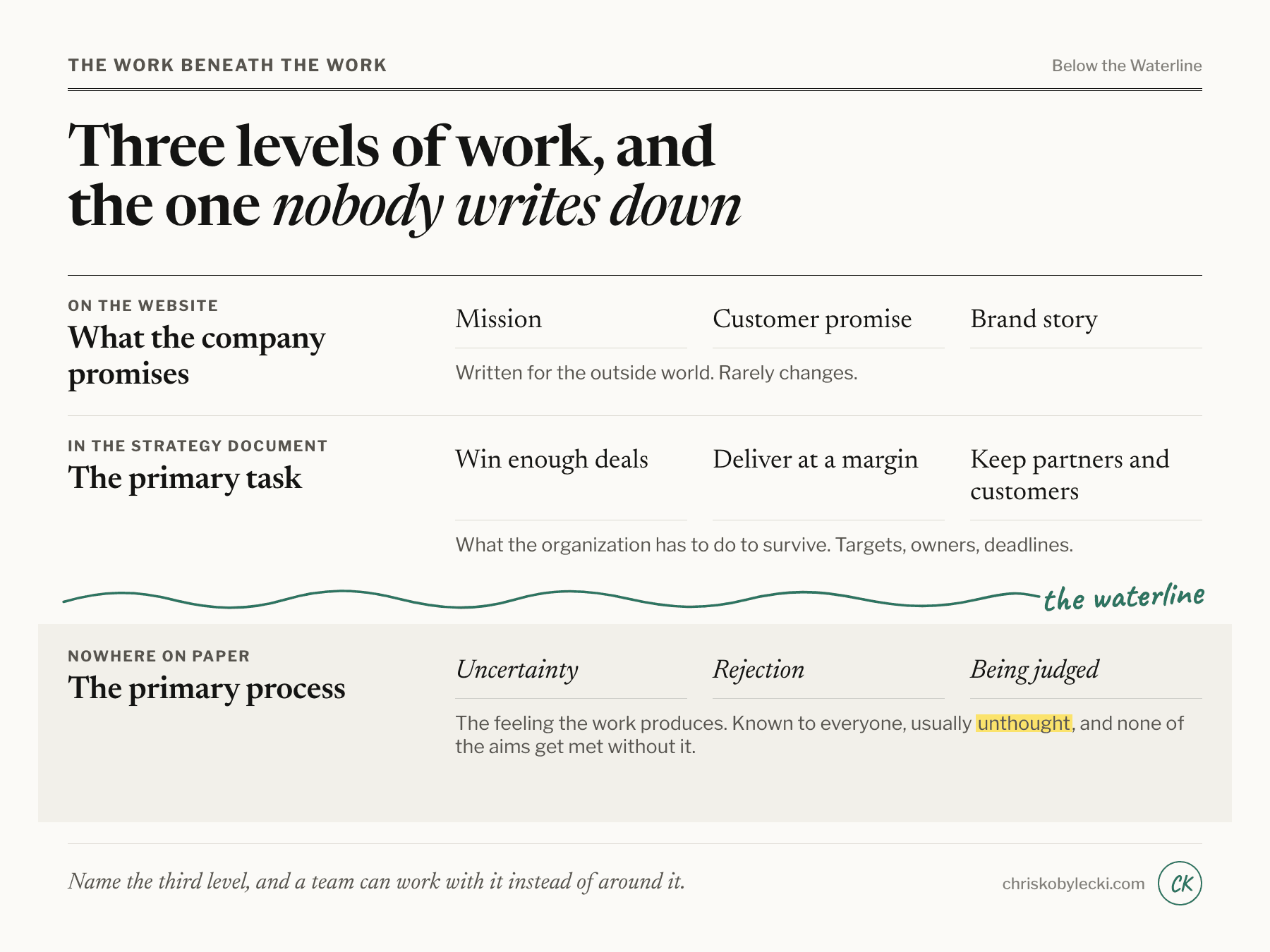
Stokes borrows a useful ladder from his colleague Gordon Lawrence. Any team's work exists on three levels: what we say we do, what we believe we do but don't say, and what we do without knowing it. His example is a national health service: officially it provides healthcare; implicitly its staff believe they are building a fairer society; unconsciously the whole country treats it as a "save us from death" service, which is why every attempt to reform it triggers emotion no spreadsheet can explain.
Your company has all three levels too. A software services firm says it delivers projects. It may believe it is proving that a company from Kraków can beat the big consultancies. And it may, without anyone deciding it, be organized to protect one founder from ever feeling not needed. Guess which level decides whether your new operating model sticks.
William Halton, drawing on the same tradition, adds the reason this material stays below the waterline: pain. Organizations, like people, push out of awareness whatever is too uncomfortable to look at: the client everyone knows is unprofitable, the product that is quietly dying, the succession question. The energy this takes is real. Teams can be intelligent, motivated, hard-working, and structurally unable to discuss the one thing that matters, because the whole system is organized around not discussing it.
Why smart teams keep it this way
Here is the part that separates this series from cynicism: the below-the-waterline organization is doing a job.
Shared pictures that are never compared save the team from discovering how deep its disagreements go. The switchboard conversation protects everyone from a conflict between two directors that feels unsurvivable. The un-made Tuesday decision spares the CEO from finding out that half the team never bought in, and spares the team from having to say it. In each case, the dynamic below the waterline is managing anxiety the team has no other way to handle.
That is why "let's just be more transparent" posters change nothing. The hidden organization exists because it solves emotional problems. Until a team can face those problems directly, it will defend its indirect solutions, politely, unconsciously, and forever.
Why I care (and why you might)
My work is turning strategy into behavior. I have written a full manual on strategy and another on OKRs, and here is what I see in practice: when these systems fail, they rarely fail above the waterline. The OKR template was fine. The strategy was coherent. What killed them lived below: a founder who could not let go, a team that could not say no to each other, a red number nobody dared to own.
Frameworks cannot fix what they cannot see. So this series goes below. Over the coming articles we will take the most useful concepts from this research tradition, one per article, and show what each looks like on an ordinary Tuesday: why busy teams avoid their real work, why groups get stupider than their members, why your weirdest process is a painkiller, why the "problem person" keeps being replaced by a new one.
Not therapy. Lenses. And a warning that applies to every article in this series: if you catch yourself using one of these ideas to diagnose an individual, you are probably reading it wrong. Look at the system.
Spot it on Monday
Three signs the other organization is running the show this week:
- Decisions that don't stick. Made cleanly, minuted, and quietly un-made within a fortnight, with no one visibly opposing.
- The meeting after the meeting. The real conversation happens in twos and threes in the corridor, on Slack, in the car. The official meeting is theater performed for the official organization.
- A recurring topic that never resolves. If the same "operational issue" has survived five leadership meetings, it is probably not an operational issue. Ask what conversation it might be standing in for.
One move: at your next leadership meeting, take the most important decision from last month and ask each person to write down, privately, one sentence on what was decided and what it requires of them. Read them aloud. You are comparing pictures, not testing memory.
Sources
- Hutton, J., Bazalgette, J. and Reed, B. (1997) 'Organisation-in-the-mind', in Neumann, J.E., Kellner, K. and Dawson-Shepherd, A. (eds) Developing Organisational Consultancy. London: Routledge.
- Stokes, J. (1994) 'What is unconscious in organisations?', in Casemore, R. et al. (eds) What Makes Consultancy Work: Understanding the Dynamics. London: South Bank University Press, pp. 312–319.
- Halton, W. (2019) 'Some unconscious aspects of organizational life: contributions from psychoanalysis', in Obholzer, A. and Roberts, V.Z. (eds) The Unconscious at Work: A Tavistock Approach to Making Sense of Organizational Life, 2nd edn. London: Routledge.