Strategy & Change · The Strategy Manual, No. 7
The Hedgehog Concept: Finding the One Thing Your Company Should Be Great At
Most leadership teams are foxes: many reasonable ideas, no single decision. The hedgehog, the BHAG and the North Star are how you choose one big thing on purpose.

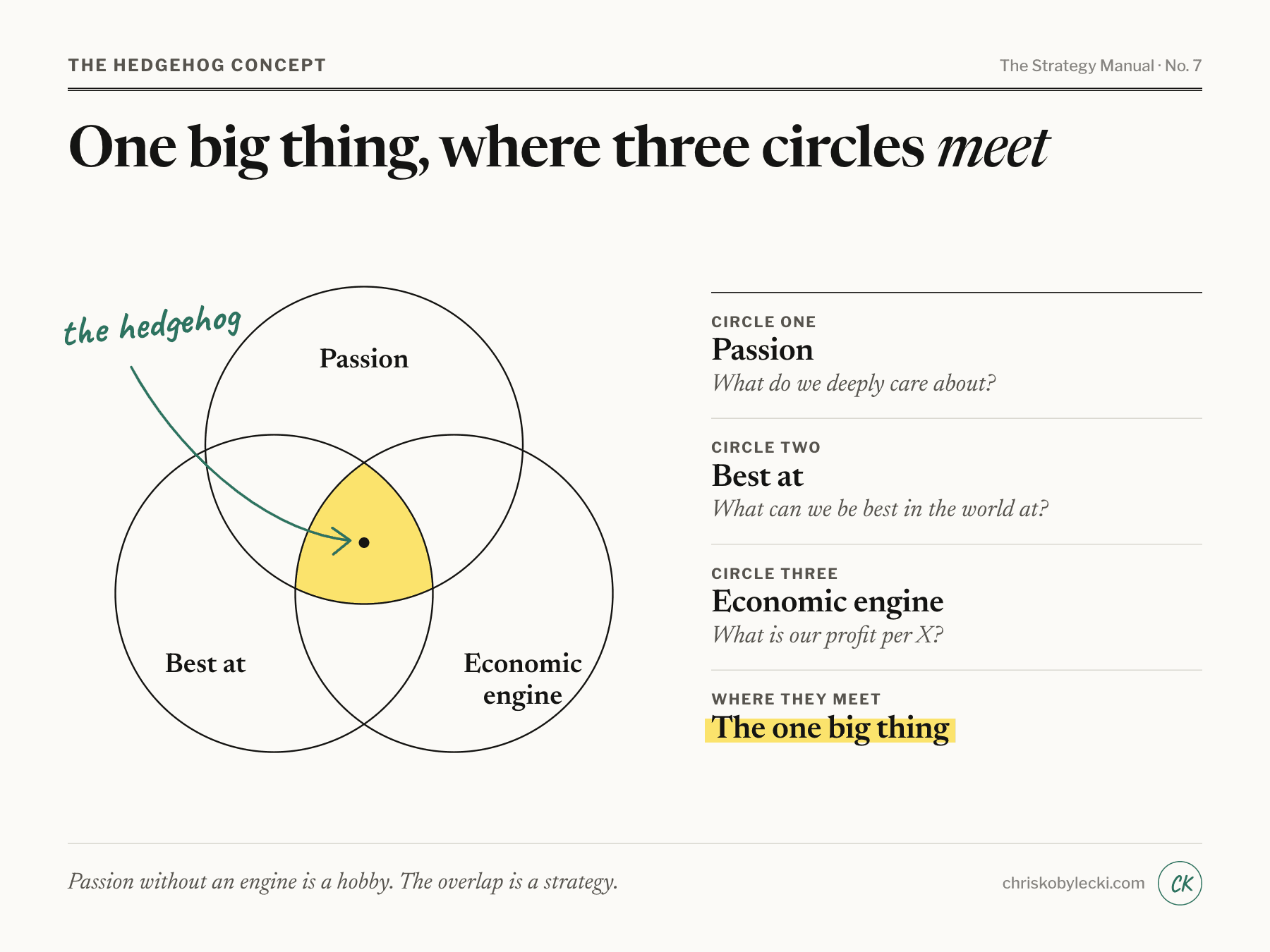
A hedgehog has one move. It rolls into a ball. The fox is faster, cleverer, and turns up every morning with a fresh plan for how to catch it, and still the fox goes hungry. Isaiah Berlin split thinkers into these two animals: the fox knows many things, the hedgehog knows one big thing. Jim Collins borrowed the split for companies in Good to Great, and it has quietly become one of the most useful foundation tools we bring into a room.
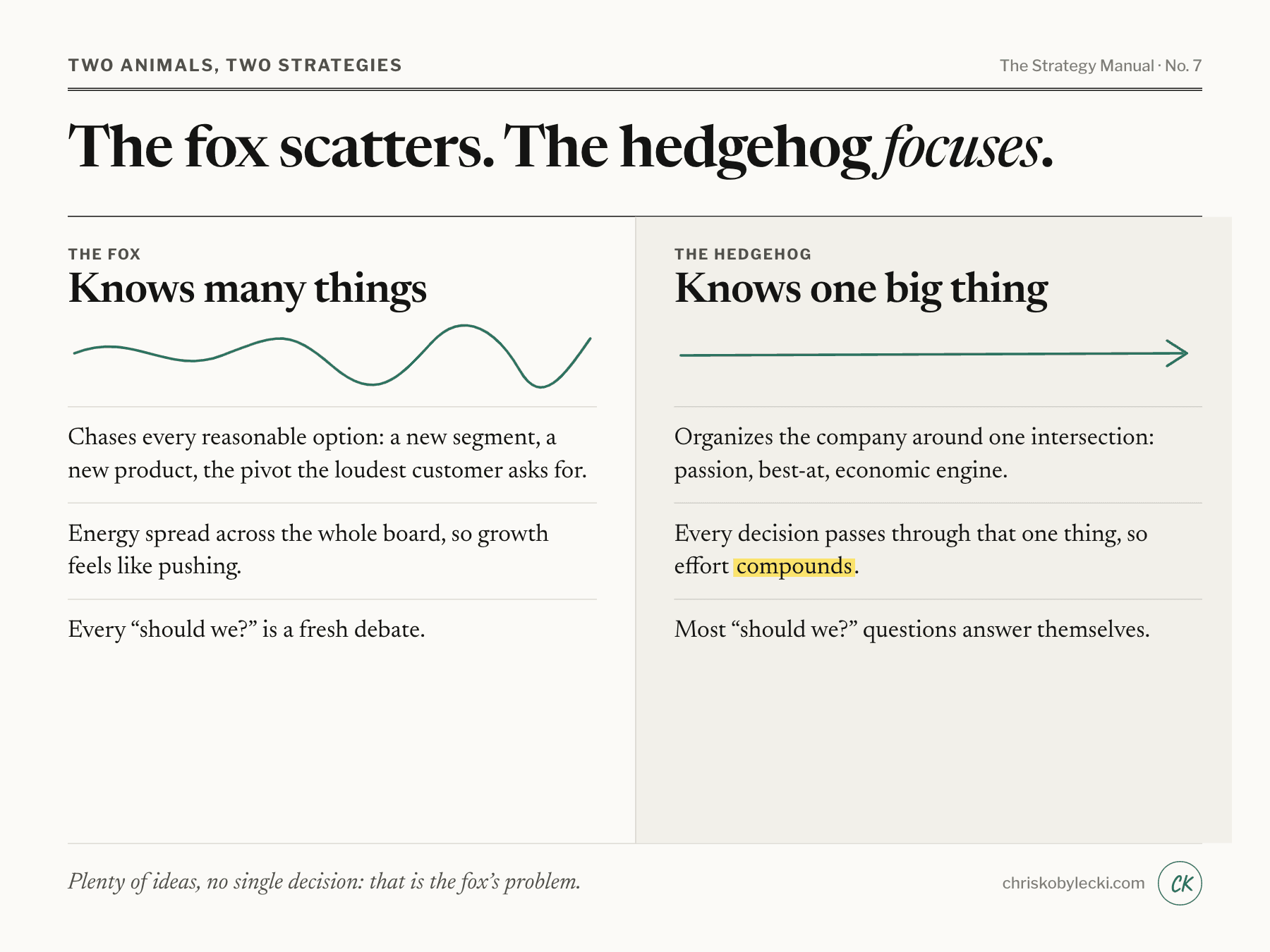
Most leadership teams we work with are foxes. Not because they lack discipline, but because every option in front of them looks reasonable. A new segment. A new product line. A partnership. A pivot the loudest customer keeps asking for. The fox's problem is the absence of a single decision about which idea the whole company is built around, not a shortage of ideas.
The problem, as it shows up in the room
Pete, the CEO, opens the offsite with a slide of twelve initiatives. All twelve are defensible. Half of them are already half-funded. When we ask which one the company would defend if it could only keep one, the room goes quiet, then everyone answers differently.
That silence is the real state of the strategy. The company is doing many things adequately and no single thing greatly. Its energy is spread across the whole board, which is why growth feels like pushing, not pulling. This is the fox running out of breath.
The Hedgehog Concept exists to end that silence. It is a focus, distinct from a mission statement or a goal: the one intersection your company organizes everything else around.
The tool: three circles (Jim Collins)
Collins found that companies which made the leap from good to great shared a deep, simple understanding of where three circles overlap. The value is in the intersection, not in any single circle.
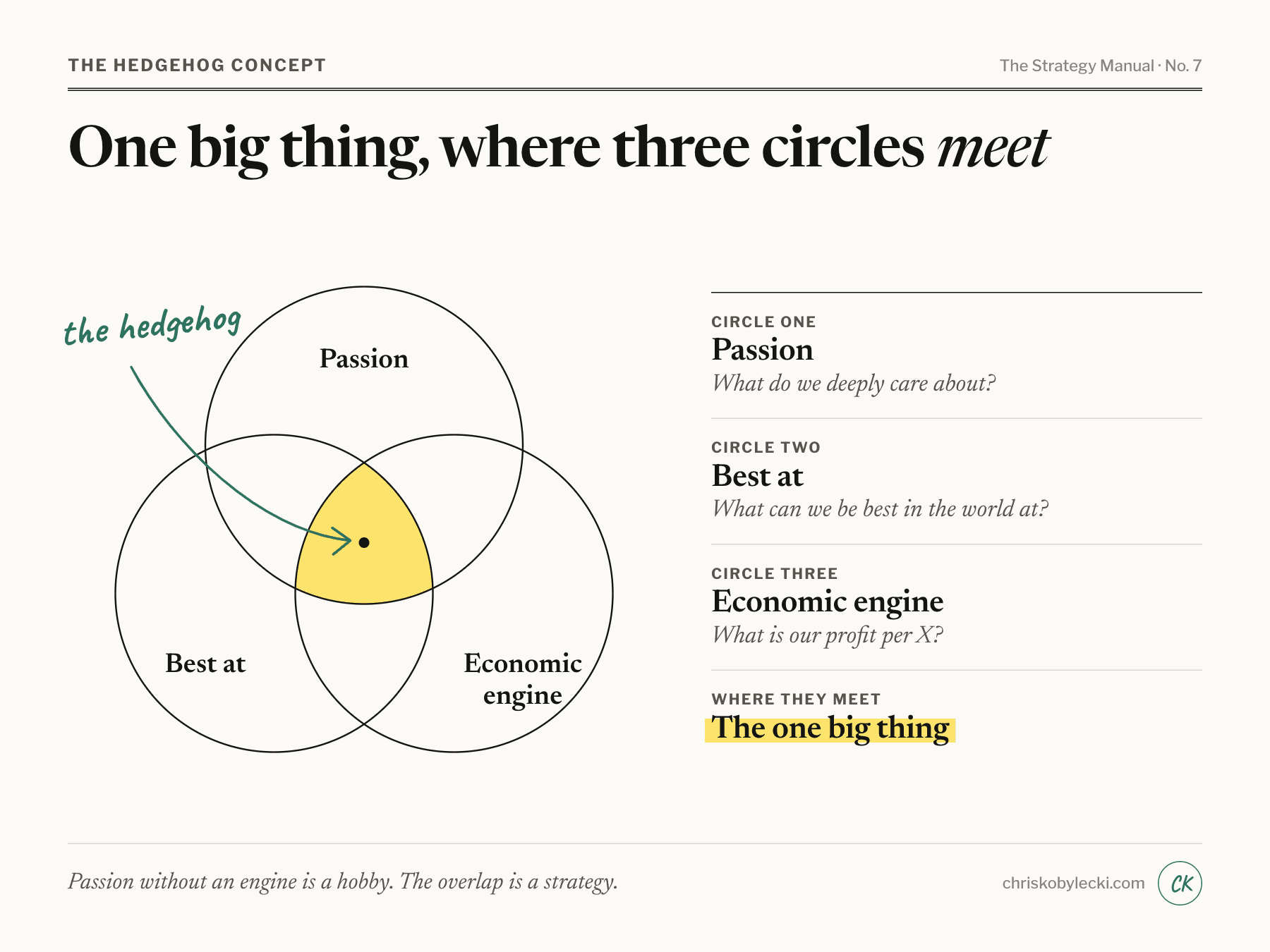
What are we deeply passionate about? Not what we tolerate, and not what pays the bills today. The work the team would still care about on a bad quarter.
What can we be the best in the world at? Honest emphasis on can. This asks where you already have the raw material to be great, not where you hope to be, and, just as important, where you cannot. Plenty of things you are good at will never be things you are best at. The hedgehog tells you which.
What drives our economic engine? The single denominator that best explains your profit. Collins calls it "profit per X." Profit per customer, per employee, per location, per record. Find the one X that, when it moves, moves everything. (Choosing it is harder than it looks; see "Profit per X is a question about your strategy" below.)
The concept lives where all three meet. Passion without an economic engine is a hobby. An economic engine without passion is a job nobody defends. Being best at something the market will not pay for is a museum piece. Only the overlap is a strategy.
A hedgehog concept example, worked through
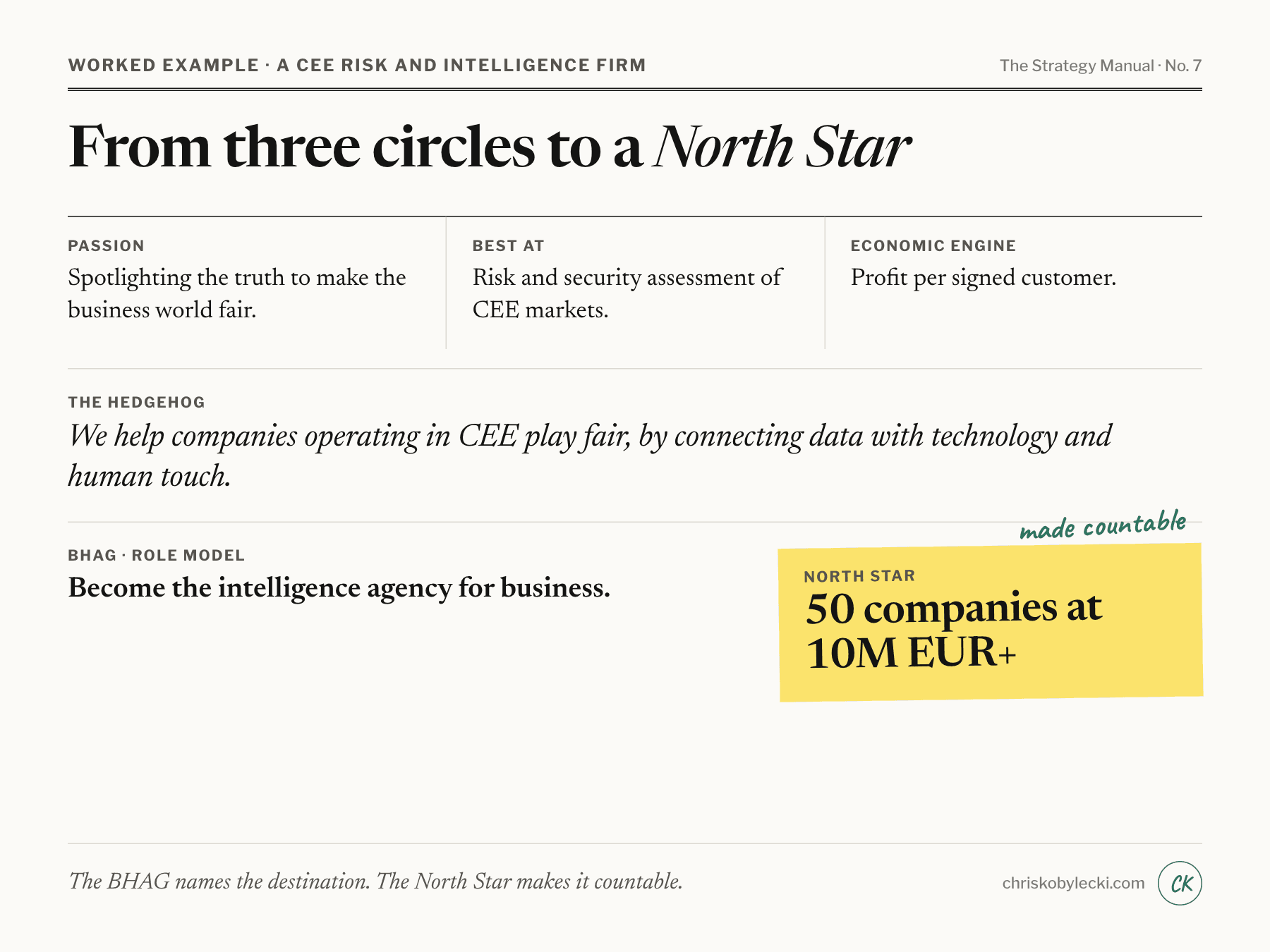
Abstract circles are easy to nod at and hard to use, so here is a real one: a risk and security intelligence firm working across Central and Eastern Europe (CEE).
- Passion: spotlighting the truth to make the business world fair.
- Best at: risk and security assessment of CEE markets.
- Economic engine: profit per signed customer.
The intersection reads as one sentence the whole company can repeat: we help companies operating in CEE play fair, by connecting data with technology and human touch.
Notice what that single sentence does. It names who the customer is (companies operating in CEE), what the firm stands for (a fair market, built on the truth), and how it wins (data, technology, and human judgment together, not one without the others). A cheap, data-only competitor is now easy to tell apart from. Before the hedgehog, "should we chase that commodity report request?" was a debate. After it, it is a five-second decision. The concept earns its keep in the meetings you no longer have.
What is "profit per X"?
Profit per X is the third circle of Collins's Hedgehog Concept: the one denominator that best explains how your company makes money, such as profit per customer, per employee or per location. Choosing X is itself a strategy decision. A good X is the event that proves your strategy worked.
Profit per X is a question about your strategy
I recently ran the Hedgehog for a group of founders at an event, and the same snag showed up that has shown up for years. The third circle gets treated as arithmetic. Pick a denominator, divide profit by it, put the result on a dashboard. Profit per customer, done, next slide. The X shrinks to a single KPI.
Collins's own example points somewhere else. For Southwest Airlines the X is a plane in the air. Read it from the other side: a plane sitting on the ground earns nothing, so the whole airline has to be built around getting planes up. The denominator came out of an insight about where the money is made, and it tells everyone what sits in the center of the strategy. The ratio is what you get after that choice, not the choice itself.
The same logic applies to a services company that wants to divide profit by clients or by contracts. The count is easy. What matters is what a client or a contract represents for your organization. Is it a client you made a change for? A client who is satisfied with your service? A client who did something, or went through your process and reached a successful end? Each answer describes a different company, and each one rewards different behavior. Signed customers reward the team that sells. Clients who changed something reward the team that delivers.
Before you commit to an X, ask what actually changed in the business when that number moved. If the only answer is "we have more of them," you have found a unit of counting and the economic engine is still unnamed. A good X is the event that proves your strategy worked, which is why it can only come from the depth of the strategy and never from the finance template.
Look back at the CEE firm above. "Profit per signed customer" holds up only if a signature stands for something that firm cares about. That is a question for its leadership team to answer, and the answer would sharpen the whole hedgehog.
From hedgehog to BHAG: giving the focus a horizon
A hedgehog tells you what you are. A BHAG, Collins's Big Hairy Audacious Goal, tells you where that one thing is going over the next decade or more.
A BHAG is a stretch goal with a specific texture. It should:
- feel roughly 70% achievable, daring enough to be uncomfortable, not so far as to be a fantasy
- be clear and compelling enough to picture, not just parse
- expand your current capabilities, so reaching it forces the company to grow
- be measurable
- connect directly to the hedgehog: passion, best-at, and profit-per-X
- run long, usually 10 years or more
Our intelligence firm's version is bold and short: become the intelligence agency for business. It is easy to picture, it stretches what the company is, and it grows straight out of the hedgehog. Notice it is not yet a number. A BHAG names the destination; the number that makes the destination countable is the North Star, which comes next.
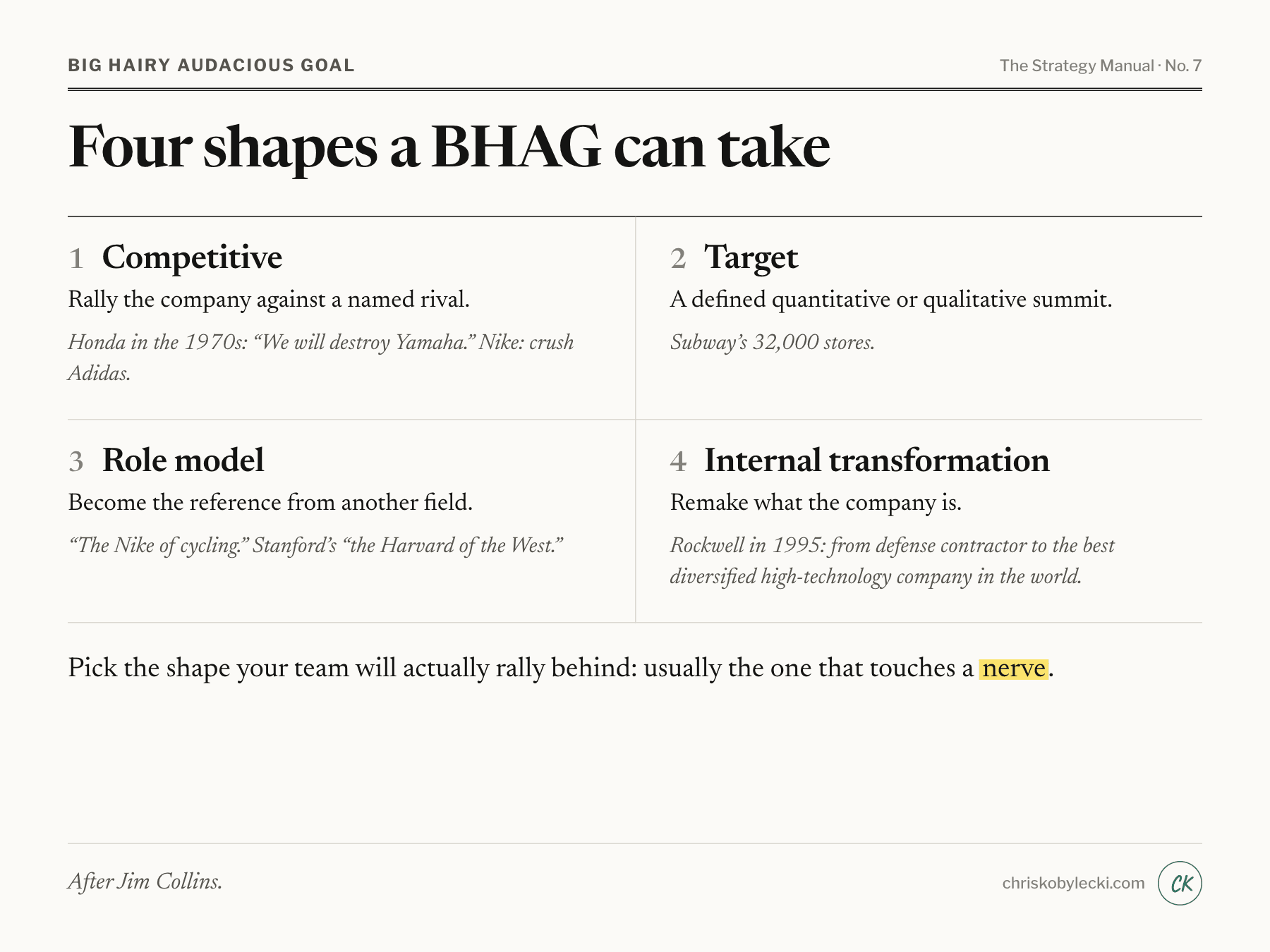
Collins names four shapes a BHAG can take, and picking the shape is itself a choice:
- Competitive: beat a named rival. Honda in the 1970s: "We will destroy Yamaha." Nike: crush Adidas.
- Target: a defined quantitative or qualitative summit. Subway's 32,000 stores.
- Role model: become the reference from another field. "The Nike of cycling." Stanford's "the Harvard of the West."
- Internal transformation: remake yourself. Rockwell in 1995: turn a defense contractor into the best diversified high-technology company in the world.
None of these is more correct than the others. The right shape is the one your team will actually rally behind, which is usually the one that touches a nerve someone in the room already feels.
North Star: the operational form
A BHAG lives at the horizon. A North Star is how you keep moving toward it this year without losing sight of the mountain. It is the BHAG's operational expression: the single measure that tells you, quarter by quarter, whether the company is moving toward its one big thing.
For our CEE firm, the destination is "become the intelligence agency for business." The North Star makes it countable: signed contracts with 50 companies that each have 10M EUR+ in yearly revenue. One number, welded to the economic engine, that anyone in the company can hold in their head. And because it is a clean, countable measure tied to strategy, it can be written as an Objective with Key Results. That is deliberate. It is the seam where this manual hands off to the OKR Manual: the North Star is where a foundation stops being a poster and starts being something a team is measured on, in behavior, not slides.
How it worked at Leave a Mark
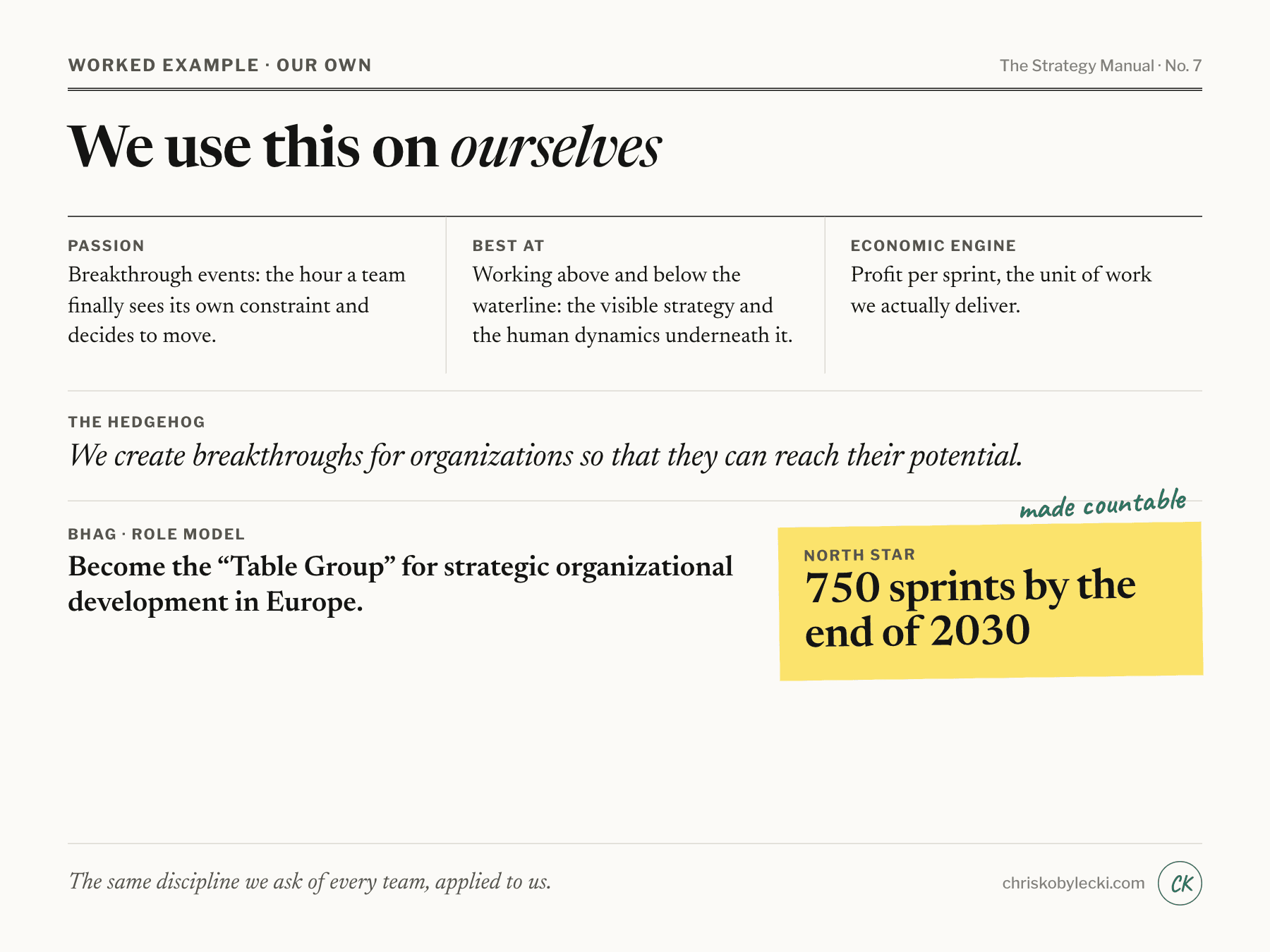
Here is the same shape applied to a company I was part of. At Leave a Mark we put every leadership team we worked with through this exercise, so the team ran it on itself too.
- Passion: breakthrough events. The hour a team finally sees its own constraint and decides to move.
- Best at: working with organizations both above and below the waterline, the visible strategy and the human dynamics underneath it, so they develop on purpose instead of by accident.
- Economic engine: profit per sprint. The sprint was the unit of work the company actually delivered, so the sprint was its "profit per X."
Read together, that was the hedgehog: we create breakthroughs for organizations so that they can reach their potential.
The BHAG followed the role-model shape from earlier: become the "Table Group" for strategic organizational development in Europe, a reference others measure themselves against. The North Star that made the ambition countable was 750 sprints by the end of 2030, one number the team was measured on, in behavior, not slides.
Common mistakes
Treating the three circles as three separate goals. Teams walk out with "be more passionate, get better at X, improve margins" as three workstreams. The value is the intersection, not the list. If you can do all three and still not name the overlap in one sentence, you do not have a hedgehog yet.
Treating profit per X as a KPI. Teams pick a denominator because it is easy to measure and stop there. Ask what the X stands for in your business and what had to change for it to move. The answer is your strategy, which no spreadsheet will give you.
Confusing "best at" with "good at" or "want to be best at." The circle is a mirror, not an ambition. The most useful outcome of this exercise is often the thing you are good at that you finally admit you will never be best at, and stop funding.
A BHAG with no connection to the engine. "Reach €100M revenue" is a number, not a BHAG, if nothing about your passion or your best-at makes that number the right one. Untethered numbers produce activity, not focus.
Skipping straight to the BHAG because it is more fun. The audacious goal is the exciting slide. But a BHAG built before the hedgehog is a fox's goal: bold, memorable, and pointed at nothing in particular. Sequence matters. Foundations before ambition, ambition before targets.
This is a foundation tool, so a word on who needs it. If your leadership team already finishes each other's sentences about what you are best at and why, you may not need a workshop here, only a check that your BHAG still connects to it. If the twelve-initiative slide sounds familiar, this is the tool. You do not need every block in the department store to hang the painting. Sometimes you need this one hammer.
TEAM QUESTION
What connects our passion, our possibility to be the best, and our economic engine?
And: what is our greatest ambition for the next 10-20 years, and does it grow out of that intersection, or float above it?
Take these two into your next leadership meeting. If the room answers the first question three different ways, you have found your most valuable hour of the quarter.
The hedgehog sits alongside your mission, your values, and the game you have chosen to play (covered in Article 6 and Article 8). But of all the foundation tools, it is the one that most directly changes what happens on Monday, because it turns a hundred small "should we?" debates into one settled decision the whole company already knows the answer to.
That is the test we hold every foundation to: whether it changes a decision, not whether it reads well on a wall. Strategy that becomes behavior starts here, with one big thing, chosen on purpose.